Two years after electing to join the IBEW, the workers at the Shell Monaca Facility in Beaver County, Pa., overwhelmingly approved their first contract April 16.
They will form the initial membership of Monaca Local 724, a newly chartered manufacturing local.
Every first-contract negotiation is different. The parties will have unique histories, attitudes and demographics.
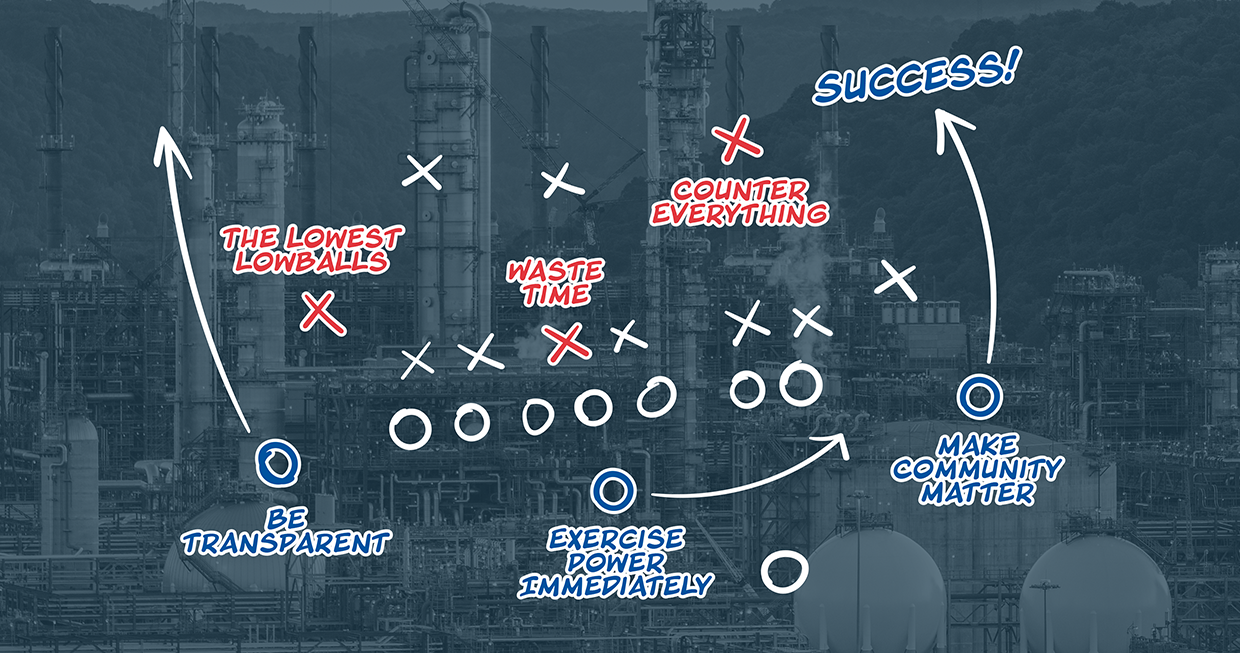
But there is a negotiation playbook that nearly every company pulls from for strategies and tactics to delay and dispirit newly formed unions. The negotiating team at Local 724’s successful fight for a first contract can serve as a blueprint for any organizer or newly organized unit in the IBEW.
“We have raises, a grievance policy, much better healthcare, and our own local,” said Rick Hindes, the newly appointed business manager. “But I’ll be honest with you, it wasn’t easy. There were times when we thought we may never get a contract.”
“I say in every campaign, ‘Winning the election is the easy part.’ It gets really hard in the negotiations because the enemy of momentum is delay, and companies have many tools and a lot of incentives to slow everything down,” said Joe DiMichele, director of professional and industrial organizing.
Most American workers don’t have a collective bargaining agreement, though more than two-thirds want one. Most have no idea how to build their own union or what to expect if they try.

Delay, Dispirit, Decertify
Local 724 had a real advantage going into the first negotiations. The organizing drive was fast and quiet.
“From the first call to the vote was five months,” said Michael McGee, former international lead organizer and now regional organizing coordinator. “When we presented a majority of authorization cards [in May 2024], management was genuinely surprised. When we asked for voluntary recognition, Shell refused. The next day we filed the NLRB Petition for Election. Later we found out that Shell did not believe we had majority support and was very surprised when we filed the petition.”
Even though Shell USA is a Texas-based company, it didn’t deploy the most aggressive union-busting tactics before the election — none of the members of the volunteer organizing committee were fired, there were no captive audience meetings and no “union avoidance” consultants were brought in. McGee said there were just a handful of emails with some unconvincing messages about the workers and the multibillion-dollar petrochemical giant being a “family.”
(You can read the full story of the initial organizing drive in the September 2024 issue of The Electrical Worker.)
The transition to negotiations was quick, McGee said, but that was all that went quickly. Agreement took 21 months. There is no “average time” between the celebration of a successful union election and the ratification vote for a first contract. Corporations often use first contract negotiations as a second shot to break the union.
“They were tough to bargain with. That’s why it took so long. They fought us on every single issue,” McGee said.
In the 100 years since the passage of the National Labor Relations Act — written to encourage the formation of unions and protect labor rights — courts, regulatory agencies, Congress and ever-larger corporations have fought its enforcement. The highway to collective bargaining envisioned by the authors of the NLRA is now a maze inside a swamp.
Critically, nothing Shell did was particularly illegal or, more important, unexpected. Anyone who wants to turn a union organizing win into a first contract should expect similar tactics.
Waste Time
Workers vote to join a union in nearly every case to solve problems with their pay, rising healthcare costs, and a lack of consistency or respect.
It is critical that negotiators and rank-and-file members remember that the goal of company negotiators is to slow things down, DiMichele said.
“Expect them to hold major issues for later, bring up secondary issues first and then stay on them,” he said.
In this negotiation, Local 724 President Shaun Butler said one of these issues was a boot allowance.
The chemicals in the petrochemical plant eat through the soles of work boots, even the so-called chemical-resistant ones. A common request of the membership was a boot allowance that covered most of the cost of replacements.
“We spent five days talking about boots,” Hindes said.
The negotiating committee worked full shifts. All of their negotiating time came out of their time off: time away from family, time away from work. Across the table were professional negotiators on company time.
“Five of our off days were about negotiating $100 extra,” Hindes said. “It was unbelievable how they would stall. And they didn’t have reasons for disagreeing with our proposal. They just said: ‘No. Less.’ You just have to understand what they are really doing.”
Another delay tactic, McGee said, was reopening agreements once they had been settled.
“One time, we got to an agreement. And we’re all happy coming in the next day,” McGee said. “They sit down and their lead negotiator says: ‘I don’t have the authority to say what I said yesterday. We are back to square one.’ It was like a bomb went off in the room.”
The Lowest Lowballs
Employers are required by law to “bargain in good faith,” but a century of pro-corporate regulations and court decisions has muddied what good faith actually means.
National Labor Relations Board regulations make it illegal for employers to punish workers for organizing, including by cutting their pay or benefits. Any first contract will, by law, have to be at least as good as the contract workers already have.
That does not stop employers from trying.
“They started with offers that were far less than we were making. When we said this was illegal, they said, ‘We can always declare an impasse,’” Hindes said.
The lead negotiator, Third District International Representative Mike Kwashnik, even told the company that its offer “wasn’t where they legally needed to be” and, therefore, wasn’t in good faith, McGee said.
McGee and the negotiating team had no great options. They could not accept the impasse declaration, which would allow Shell to impose its position unilaterally. They could file an unfair labor practice complaint with the NLRB, but the board had too few members to issue rulings after President Donald Trump illegally fired board Chair Gwynn Wilcox. Trump took nearly a year to appoint enough members for the board to function, but few unions would look to the new pro-corporate majority for help.
The only choice is to stay calm, stay at the table and grind away.
Counter Everything
Whatever proposal you make, no matter how justified or supported by evidence, expect a counter. Just don’t expect a justification.
“They never, ever said yes. No matter what, their counter was less. No reason. Just … less,” McGee said. “Expect it to not make sense.”
For example, most unionized Shell factories are represented by the United Steelworkers. In response to certain proposals, Butler said, the company would say no because “the USW doesn’t get that.”
But if they did propose something that was in USW contracts, the company said this facility was different.
Fight The Playbook
The key to surviving these tactics is remembering that the company’s strategic goal isn’t winning better terms in a contract but avoiding a contract entirely.
NLRB rules allow a decertification campaign to begin a year after a successful union election.
A unit that sees endless delay can lose heart. It becomes vulnerable to management that says, “We told you it will be worse when the union steps between us.”
People who opposed the union might see their working conditions improve. They might receive information, training and support to start a decertification campaign.
But, if the unit votes to decertify a union, all of the worker protections go away.
It is illegal to fire workers who engaged in protected organizing activity before a vote and during negotiations. After a decertification vote, anyone can be fired, for any reason or no reason at all. The company can change any policy, cut anyone’s wages or hours.
Knowing these are the stakes helped mentally prepare Hindes, Butler and the organizing committee.
“We told management: ‘We don’t care if this goes five years. You can keep flying up, and we’ll keep showing up,’” Hindes said. “It wasn’t personal between us and management, but it was personal for the people who work here. This was about our families. Our kids. Our futures.”
Transparency and Frequency
The bare minimum is honest and regular communication with the bargaining unit.
Shell is the 23rd-largest company in the world, with assets of over $370 billion and annual revenue of $267 billion, according to Forbes. It has more than 100,000 employees, including 18,000 in the U.S.
Shell employed a team of professional negotiators, some of whom flew in from Houston for each negotiation.
The Monaca unit has 205 members. Outside Kwashnik and McGee, the organizing committee and then the negotiating committee included Hindes, Butler, Chief Steward James Frederick, Harley Resse (now financial secretary), John Baker (now executive board member) and Rich Morris (now recording secretary and executive board member). They were volunteers who worked after full shifts out of donated offices in nearby Beaver, Pa., Local 712’s hall.
The power imbalance between those two groups is impossible to overstate. As weak as it is, labor law gives union negotiators real power, DiMichele said, but completely overcoming the imbalance takes a united, informed membership. “The VOC has to be strong and committed,” DiMichele said. “It has to seek out every opportunity to keep the members informed, and it has to tell them as much of the story as they legally can.”
For Hindes and Butler, that meant scheduled formal meetings with the bargaining unit and frequent informal conversations with individuals and groups.
They never disturbed anyone on their job, but every other moment was fair game.
“We didn’t talk about fishing. People asked us, and we answered,” Hindes said. “We gave them a lot of information without spoiling the negotiations, and we reminded them of the benefits of staying strong and the costs if we didn’t.”
DiMichele said every interaction should include updates on negotiations, but also time to listen to frustrations.
If there is a classification or unit where support is low before the election, McGee said, the days and weeks after the vote are the critical time to bring those “no” votes on union side.
“We held meetings right after the vote to keep momentum and sought out the no votes to say: ‘The election is over. You’re part of it. Let’s get what you want. So, what do you want?’” McGee said. “What do you want to keep? What policies do you want to get rid of?”
Have everyone write down what they want, ranked one to five. Collate a top 10 and look for asks that are very important to smaller groups. Bring that back to membership and incorporate it into negotiations.
“After a lifetime on the job just taking whatever management gives you, it can take a while for the unit to start thinking hard about what they really want for themselves,” McGee said.
And the longer negotiations go on, the more important communication becomes.
“It was hard because sometimes you had nothing new to say or nothing new you could say, but you still had to show up and explain, no matter how frustrated you were yourself,” Butler said. “The only thing in our control is building unity.”
Exercise Power Immediately
A union doesn’t need a contract to protect a member from being unfairly disciplined or fired.
“Train stewards immediately,” Hindes said. Local 724 had steward training, taught by Third District Education International Representative Larry Neidig III, within days of the election certification at the very start of negotiations.
There were no grievance procedures to protect, no jointly negotiated working conditions policies to enforce and no negotiated role for stewards in an official disciplinary procedure.
The union is the official representative for the unit with or without a contract.
Only two weeks after the certification vote, a panicked member called Hindes at home, asking him to come back down. The worker was going to be fired because he had missed something important, a safety violation.
Butler did what stewards are supposed to do. He investigated for himself, and the straightforward story of a worker making a critical mistake was not straightforward after all.
“This guy had asked the company safety manager if he was doing it right, and the manager walked him through the job and approved the paperwork,” he said. “In the past they would have fired this guy, but, I said, ‘If you’re going to fire our guy, you have to fire everyone involved.’”
The company “circled their wagons,” Butler said, and in the end, neither the worker nor the managers were disciplined.

Butler didn’t need a contract or a disciplinary procedure to save the member’s job. He had the power to represent the workers.
“You are equal to them at the table. When I, Rick or Kwashnik speak, we speak for 200 people. You don’t have to be nervous or afraid. There is no more bullying because ‘I can fire you for no reason.’ Not here you can’t. Because I’m not just me, we’re us,” Butler said.
It is true that an organizing group can’t control the company’s timeline or NLRB panel decisions, DiMichele said.
“But we don’t have to. Any unilateral changes to policies, we can object. You never have to go into another disciplinary meeting alone again as soon as the union is voted in,” DiMichele said. “Nothing will change a person’s mind faster than a skilled steward saving their job. That’s power you need to use during the slog of negotiations.”
Make Community Matter
Beyond the informational duties and the exercise of power, VOCs built for long-term success seek out opportunities outside negotiation updates to build solidarity and connection.
This can take many shapes, DiMichele said.
“Think family picnics. Motorcycle toy runs. T-shirts. Solidarity nights. Bowling. Dances,” he said. “Especially in more rural places, this is big. Not every place has everything. Unions aren’t just about what percent raise you get. They are about building community and working-class power, and that should be fun.”
At Monaca, what worked best to build bridges was hot dogs.
“All-day dogs. It’s huge,” Hindes said.
It started simply, Butler said. A member’s wife has terminal cancer. The committee wanted to raise money for the couple. One Wednesday, he dragged a hot dog roller to the plant, bought $200 of hot dogs and sold them, all proceeds to the member and his wife.
They’ve raised at least $5,000, and now it’s a Wednesday tradition.
“Everyone can eat: hourly, salary, even contractors. You can talk with people who don’t love the union. We can just show them who we are, respond to rumors, tell the truth,” Butler said. “And it’s a simple way to show, yeah, we did this for Jim, but we’ll do this for you. This is why we’re union. We take care of our own.”
Stay in the Game
None of that will force a company to agree to a contract it doesn’t want. But all of it buys you leverage at the bargaining table and gives negotiators time.
“Opportunities will come, even against the biggest companies. You have to be at the table when it does,” DiMichele said.
For the Local 724 negotiators, that opportunity arrived in July 2025. Shell wasn’t getting the returns it wanted from its chemical division, including the Monaca plant. The company announced that the entire division was up for sale.
An unresolved contract dispute was a risk that the company no longer wanted to carry into that sale.
“All of a sudden, their lead negotiator said, ‘How do you think we could get this done?’” McGee said. “And just like that, they were willing to bargain.”
It still took some time, and they didn’t get everything they wanted. But they did get a contract.
Critically, it included a successor clause so that any company that buys the facility has to respect the contract and negotiate with the union.
“It is the oldest lesson there is: Never stop organizing,” DiMichele said.
The contract contains a 12% raise over three years, which includes 5% in back pay from an increase Shell held back in February; a $10,000 signing bonus; a $250 boot allowance; and participation in the IBEW-run Family Medical Care Plan, which Hindes said is “better healthcare than we were getting for a much lower cost.”
When the contract went to the membership, it was overwhelmingly approved, far outpacing the original organizing election.
“The successful ratification represented far more than the approval of a first contract — it reflected the determination, unity and perseverance of workers who came together to improve their working conditions and build a stronger future for themselves and their families,” Kwashnik said.
The charter will be officially signed Aug. 5 in Local 712’s union hall.
“So many people think the union comes in and shakes a contract out of a company. It isn’t true. You either make your own union or it’s never there. We’ll train you. We’ll help the whole way. But you don’t hire us, you become us,” DiMichele said. “You get the future you want by doing the work.”