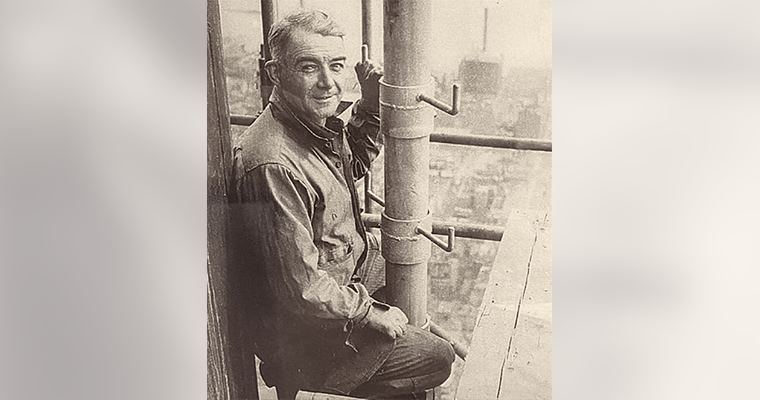

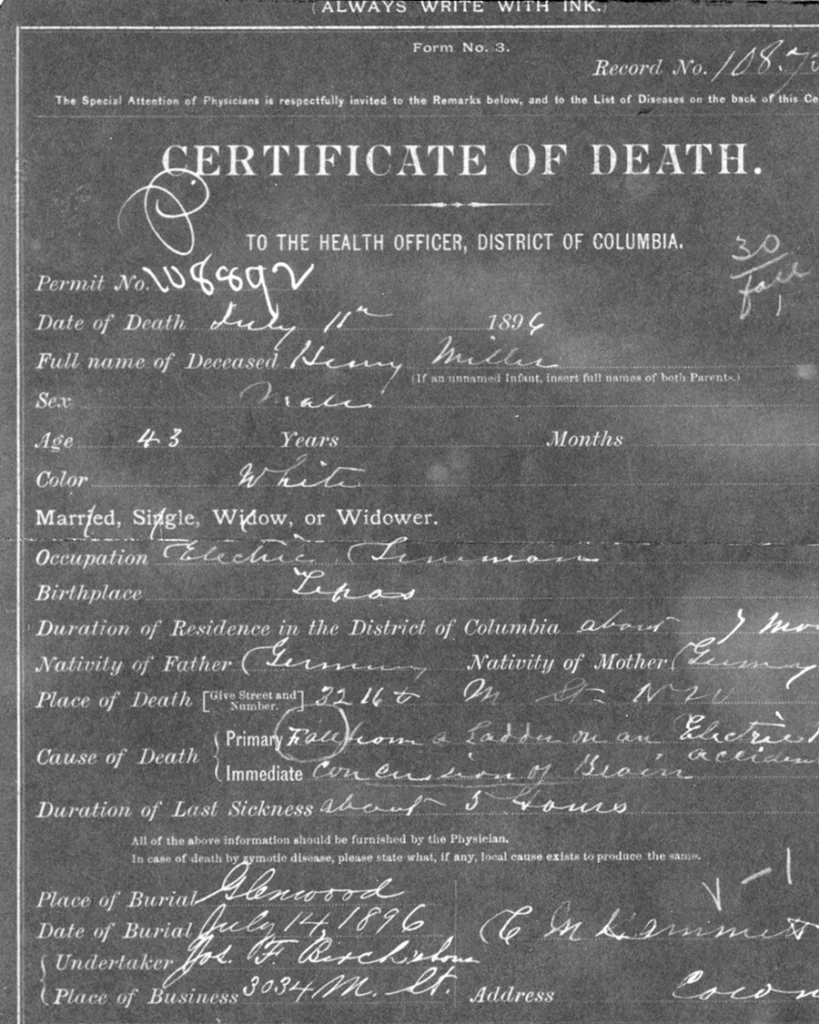
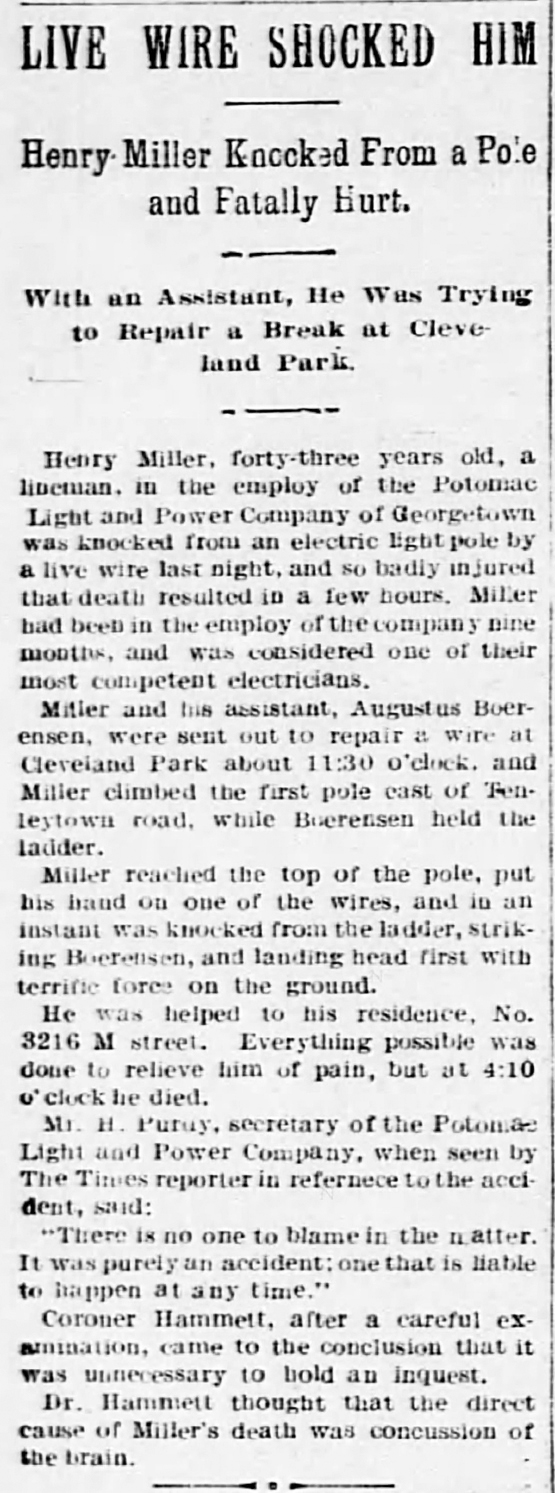
This month marks the 130th anniversary of the death of our founder and first president, Henry Miller. On July 10, 1896, Miller came into contact with a live wire while on top of a pole, instantly sending 2,200 volts through his body. He suffered severe injuries from the fall and passed away a few hours later in his boarding house in Washington, D.C. His death is a reminder of the inherent dangers of electrical work and the constant vigilance our members must maintain to ensure their safety and the safety of those around them. It is for this reason that we recognize July 10 as National Lineworker Appreciation Day.
According to J.T. Kelly, IBEW’s first Secretary-Treasurer, Miller was born Jan. 5, 1858 in Fredericksburg, Texas. Hugh Murrin of Local 283 in Oakland, Calif., and later a close friend of Miller’s, recalled that his parents were German immigrants and that Miller would occasionally slip into a German accent when on the job. He lived on his family’s ranch until age 16, when he left to work for a military project constructing a 125-mile telegraph line along the Rio Grande. After a year of this informal “apprenticeship,” Miller pursued a career as a lineman.

His first post was as a line repairman for the Western Union Telegraph Co., then for the Santé Fe Railway Co. where he was given charge of a telegraph division. In 1879, Miller became a superintendent with the Erie Telephone Co. and remained with the company until 1885. Around 1886 he landed in St. Louis and found work with the Municipal Electric Light and Power Co. He also became good friends with a wireman who’d recently arrived from Pennsylvania, James T. Kelly.
In 1890, St. Louis hosted an exposition that featured an elaborate electric light display requiring dozens of linemen and wiremen to maintain. Inspired by the sight of so many of their fellow tradesmen, Miller and Kelly met with AFL organizer Charles Kassel to create Local 5221, a local union solely for St. Louis electricians. Miller was elected president and spent the next year traveling across the Midwest and East Coast, finding work in various cities, and organizing local unions along the way.
By September 1891, Miller had laid enough groundwork that 5221 felt confident in calling for a convention to establish a national organization for electrical workers. It was held Nov. 21 in the unassuming boarding house in St. Louis that Miller called home, with 10 delegates in attendance. When it concluded a week later, the IBEW was born with Miller elected as Grand President and Kelly as Secretary-Treasurer. With only $100 in the bank, thanks to a loan from 5221, Miller jumped straight back into organizing, chartering 45 local unions over the next six months.
Daniel Ellsworth, a member of Detroit Local 17, remembered the day Miller rode into town to organize. “He rode on the bumpers of a freight train to get here and had no funds for organizing. When we took up a collection for him he said ‘No, boys, you will need all the money you can get together for your union. I will get along some way.’ I tell you, brothers, he was a hero in the cause.”
At the 3rd IBEW convention in 1893, Miller became a Grand Vice President and Grand Organizer. One highlight of his new position was organizing the Adams Hydroelectric Generating Station at Niagara Falls. This was the first hydro plant designed by George Westinghouse and Nikola Tesla. An economic depression in 1894 forced Miller to return to work as a lineman.
He made his way to Washington, D.C., and signed the book with Local 26. He found work with the Potomac Light and Power Co. According to Henry Hatt, a traveling brother who roomed with Miller in Georgetown, our founder was always assigned the toughest jobs. He once witnessed Miller wire a 240-foot high-iron smokestack, working in heavy winds on the outer edge of narrow scaffolding. “He had a heart as big as a coat of mail,” said Hatt. “His efforts on behalf of the electrical workers created a momentum around which a corporate resistance occurred.” It was not only Miller’s work ethic and perseverance that impressed Hatt, but also his ability to find time for reflection and relaxation. “He could do as much work in one day as two ordinary men, and read novels half the night,” Hatt said.
On July 10, 1896, Miller was assigned to repair a lighting circuit in Cleveland Park that was damaged during a storm. Working on the line just before midnight, Miller received the 2,200-volt shock that threw him from his pole. A doctor brought him to his boarding house where he died at 4:30am on July 11. John Lloyd, a member of Local 26, said a special meeting was convened to “appoint a committee and see that Miller was properly buried. Mr. Purdy, the superintendent of Potomac Light and Power, and a good friend of Miller’s, attended the funeral in conjunction with the IBEW members.” As Miller had no money of his own, Purdy covered all funeral expenses save for $16.00 paid by the IBEW executive office. In 1901, the IBEW paid for perpetual care of Miller’s grave at Glenwood Cemetery in Washington, a service that continues to this day.

Henry Miller’s life was not easy. His occupation as an electrical worker placed him in constant risk. It was the unregulated nature of the work that inspired him to create the IBEW. Faced with low wages, little to no training, and fatality rates far and above those of any other trade, Miller understood that the only way to improve working conditions and instill dignity amongst electrical workers was to organize. In that effort, Miller’s tenacity and courage were without equal. “No man could have done more for our union in its first years than he did,” said first IST Kelly. “Every movement, every organization established, has associated with it the name of some individual whose mind conceived and whose energy and perseverance established it; and thus the name of Henry Miller will forever be associated with the Electrical Workers of America.”
Hugh Murrin wrote extensively about Miller in a 1916 issue of The Electrical Worker. “I know personally of the hardships he passed through while organizing the electrical workers. With no salary or money for expenses he traveled from city to city and depended upon the men of our trade to feed him. If we are to succeed in promoting the good work that this worthy Brother started for us… we must all work together, and if we do this I can see for the IBEW the success that was the aim and heartfelt desire of Henry Miller.”
On this year’s National Lineworker Appreciation Day, let us remember the hard work and sacrifice of Henry Miller. To tell his story is to tell the story of the IBEW.
Visit nbew-ibewmuseum.org for more on how to support the IBEW’s preservation of its history. Have a an idea for this feature? Send it to [email protected].