
Anchorage, Alaska, Local 1547 Business Manager Doug Tansy knows most of his members, and most Alaskans, have felt the impact of the state’s nation-high suicide rate.
“The numbers don’t reflect how bad it is,” he said. “Everyone I know knows someone that has been affected. It’s just too much to bear.”
So Tansy and other Local 1547 leaders reached out to The 5th Wire, a mental health and suicide prevention program spreading across the IBEW and the electrical industry.
It starts with what sounds like a simple, yet largely untried, concept: putting electricians and other IBEW members in circles and having them discuss their own lives and struggles, with the goals of connection and empathy.
It offers a way to head off suicide before someone contemplates taking their own life and long before they might be in touch with a mental health professional.
“Whenever my friends and I hear about someone dying by suicide, we scream out: ‘No way! I had no idea!’” Tansy said. “We never see it before it happens. Local 1547 had to do something different.”
Alaska’s suicide rate is 28.1 per 100,000 residents, nearly twice the national rate. Tansy noted that other IBEW brothers and sisters reached out to help him when he struggled with substance use issues as a young apprentice.
But with people on their digital devices more and talking to each other less, he’s concerned that a member struggling with mental health issues today won’t have that support.
“We need to be vulnerable and find the commonality and humanity that is part of all of us,” he said.
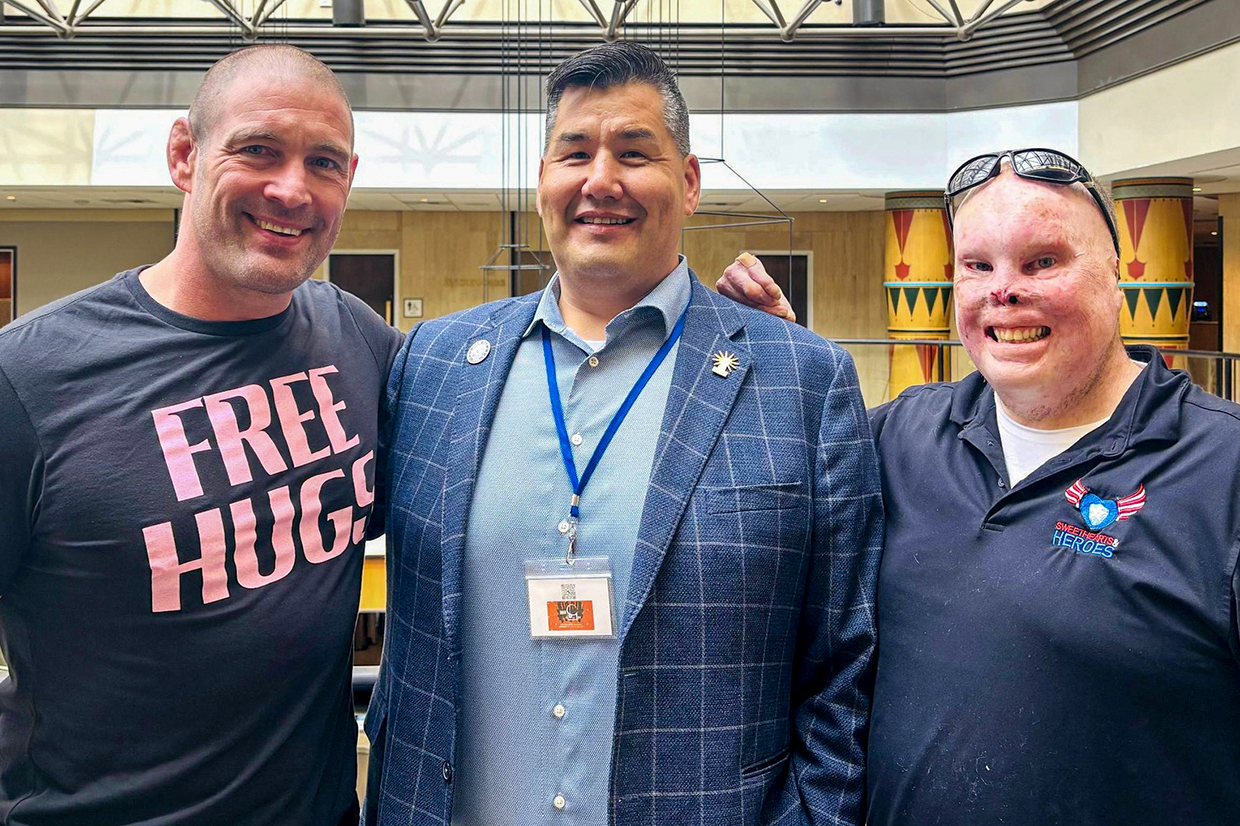
The 5th Wire’s message springs from Sweethearts & Heroes, which was founded and led by Tom Murphy, an executive in the railroad industry for two decades.
He also was an NCAA Division III national champion wrestler while at SUNY Brockport. In addition to that, Murphy excelled in mixed martial arts. He was a contestant on the second season of the long-running television show “The Ultimate Fighter” and competed in UFC 58. Coaches and friends watched and asked him to give motivational talks to teams and other groups.
Eventually, a former wrestling teammate asked him to speak to a group of middle schoolers on the importance of pushing back against bullying, thinking that a tough guy with charisma would be a good person to deliver the message.
Murphy made quite an impression. Requests from other schools and educators came in, and he found that he loved the work. He encouraged students to stand up for others, even when it isn’t easy.
He started Sweethearts & Heroes out of his home in St. Albans, Vt., and left his job in the railroad industry in 2014. About 2 million students have heard its message through live presentations, books, videos and online courses, according to the organization.

His co-founder and presenting partner is retired Army Sgt. Rick Yarosh, who was critically injured in Iraq in 2006, for which he was awarded a Purple Heart. Yarosh suffered burns over 60% of his body and lost both ears, his nose, his right leg below the knee and most of the function in his hands. Yet he still joins Murphy on stage to speak about hope and inspiration.
About 2½ years ago, Murphy received a call from the human resources department at Northline Utilities, asking what could be done to address the high rate of suicide among electrical workers. Northline employs members of Syracuse, N.Y., Local 1249, and Murphy made a presentation during a safety conference at the union’s hall.
Thus was born The 5th Wire. A single-phase electrical system uses three wires and a three-phase setup requires four wires. The lineman represents the crucial fifth wire — which keeps the crew grounded and prevents against the ultimate personal injury, suicide.
“I’m a believer,” Local 1249 Business Manager Mark Lawrence said. “Our local has made it part of our culture going forward.”
The number of Local 1249 members lost to suicide in recent years was alarming, and Lawrence said it was especially rattling when two members he regularly saw in the community took their own lives.
He’s now seen some of the biggest, toughest Local 1249 members become vulnerable and share during sessions using the techniques led by Murphy and Yarosh. They address challenges faced by all linemen, who often perform physically demanding work for long hours far away from home, that aren’t seen in many other industries.
In addition to the presentation in Anchorage, Murphy and Yarosh spoke at this year’s Sixth District and Third District progress meetings, the latter of which had International President Kenneth W. Cooper in the audience.
“I was just blown away,” Third District International Vice President Frank Muia said. “The message was powerful. It was emotional.
“We did not have anyone get up to leave during a two-hour presentation,” Muia said. “No one got up to take a phone call. You could hear a pin drop. They had everyone’s attention in the room.”
Murphy also made presentations to NECA and at SELCAT’s Outside Apprenticeship Conference in San Juan, Puerto Rico, in March.
The concept of the circles is not new, Murphy noted. Throughout history, communities have used circles for communication, which allowed all generations to build networks of support and a culture of belonging. Those steps are critical to creating a healthy community, he said.
But he noted that overall suicide rates, particularly among young people, spiked from 2010 to 2015, coinciding with the sharp increase in cellphones and social media.
“These kids that were having challenges with hopelessness are now men in the industry,” he said. “Nothing got fixed. It’s just a new set of challenges.”
Murphy’s history both in MMA and in the railroad industry — which relies on skilled construction workers, including IBEW members — makes it easier for members at his presentations to relate to him, he said.
“I know these men,” he said with a laugh. “I can bring a level of bravado, while balancing it with measured vulnerability that intrigues individuals who have largely stigmatized mental health.”
Factors such as the stress of irregular employment, the danger of the work and chronic injuries all have been cited as reasons for the high suicide rate among electrical and other construction workers.
Murphy adds another reason: People aren’t talking to each other, including members of the skilled trades, and are spending too much time on their phones.
“All we are doing [with The 5th Wire] is helping peers help their peers,” he said. “That’s what people have been doing for thousands of years, without any psychiatrists or psychologists. We have a need for mental health services in this county, but just as important, we have a need for a brotherhood that loves one another.”
The suicide rate for the general U.S. population was 14.1 per 100,000 in 2023, the last full year Centers for Disease Control and Prevention statistics are available.
Finding a precise number for electrical workers is difficult, but industry experts and mental health advocates agree that it’s higher than the national average.
A 2020 analysis by the National Violent Death Reporting System put the suicide rate among all construction workers at 47.5 per 100,000. Studies have shown that construction workers have some of the highest rates of depression and mental health issues and are among the least likely workers in the U.S. to get help.
“Mental health is not a separate issue from workplace safety, it is workplace safety,” said Ninth District International Vice President Dave Reaves. “Across the Ninth District, we’ve made a commitment to give our members the tools, training and support they need to recognize when a brother or sister is struggling and to know how to respond. Through our Mental Health Summits, partnerships with professionals like Josh Rizzo, The 5th Wire and VitalCog training for our entire Ninth District staff, we are working to break down the stigma around these conversations.
“The goal is simple: make sure every member knows they are not alone, that help is available, and that reaching out for support is a sign of strength, not weakness,” Reaves added.
The Third District’s Muia said it’s critical for the IBEW to continue to provide mental health experts for members in crisis. But it’s equally critical to follow the approach put forward by Murphy and Yarosh, having members speak openly about issues they are facing, both on the job and in their personal lives.
He also said the presence of Yarosh encourages people to take The 5th Wire seriously.
“He is one of the most upbeat people I’ve met in my life based on what he’s endured and the physical challenges he faces,” Muia said. “We all have stressful situations we are involved in in our day-to-day work with the IBEW. But if it gets really bad, I always think back to Rick.”
Yarosh and Murphy’s appearance in Anchorage left a lasting impression on Tansy, too.
“What we’ve found in some of our conversations is that people who have committed suicide felt like they had no help, no hope and couldn’t overcome the burden,” he said.
“I had some hope when I was young because of my peers,” he added. “I think we have to learn how to do it again. I don’t think it’s quite as natural for young people as it was for me and my generation. The way our people participated in this, and the way they got involved, it just shows it is something we’ve needed for a while, in my opinion. They’ve just not had a place to do it.”