
Hundreds of IBEW electrical workers with Daytona Beach, Fla., Local 756 helped NASA send four astronauts around the moon in March. While it was the space agency’s first crewed voyage beyond Earth’s orbit in more than 50 years, helping NASA and others launch all sorts of spacecraft from Florida — with or without anyone aboard — has been part of the local’s job since 1958.
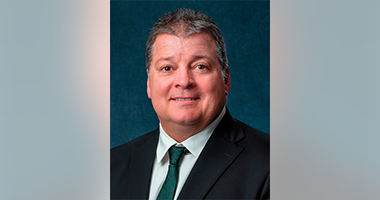
“We helped with Apollo, we helped with the Space Shuttle, and now we’re helping with Artemis,” said Business Manager Matthew Nelson, who noted that the local recently celebrated the 90th anniversary of its charter.
“The launch vehicles we don’t really touch,” Nelson said. “But the infrastructure — the launch control center, launch pads, mobile launchers — everything that gets the rocket to the pad — that’s us.”
Besides their work at the John F. Kennedy Space Center, Local 756’s highly trained electrical workers also partner with signatory contractors on the nearby Cape Canaveral and Patrick Space Force bases, as well as at other military and federal facilities along Florida’s east coast.
“We have work in town, too, like schools work, but the big thing is what people see on TV,” Nelson said.
IBEW members have been part of the Artemis project since it began nearly 16 years ago, working on structures such as Mobile Launcher 1, a 380-foot-tall platform that can ferry Artemis mission rockets on their eight-hour, four-mile trek from NASA’s Vehicle Assembly Building, or VAB, to Launch Pad 39B.
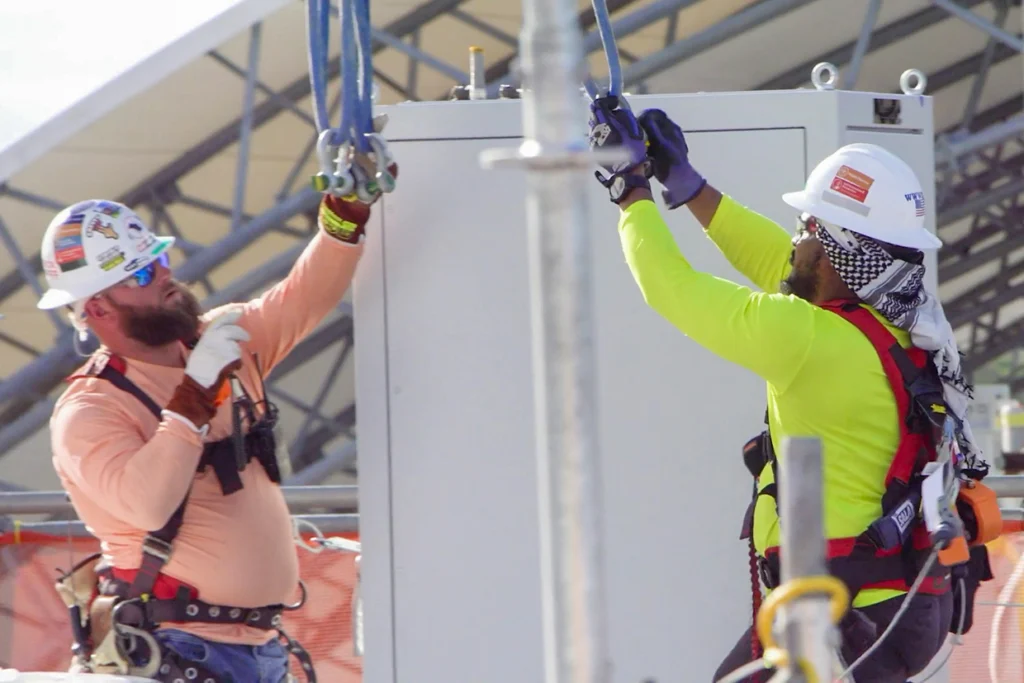
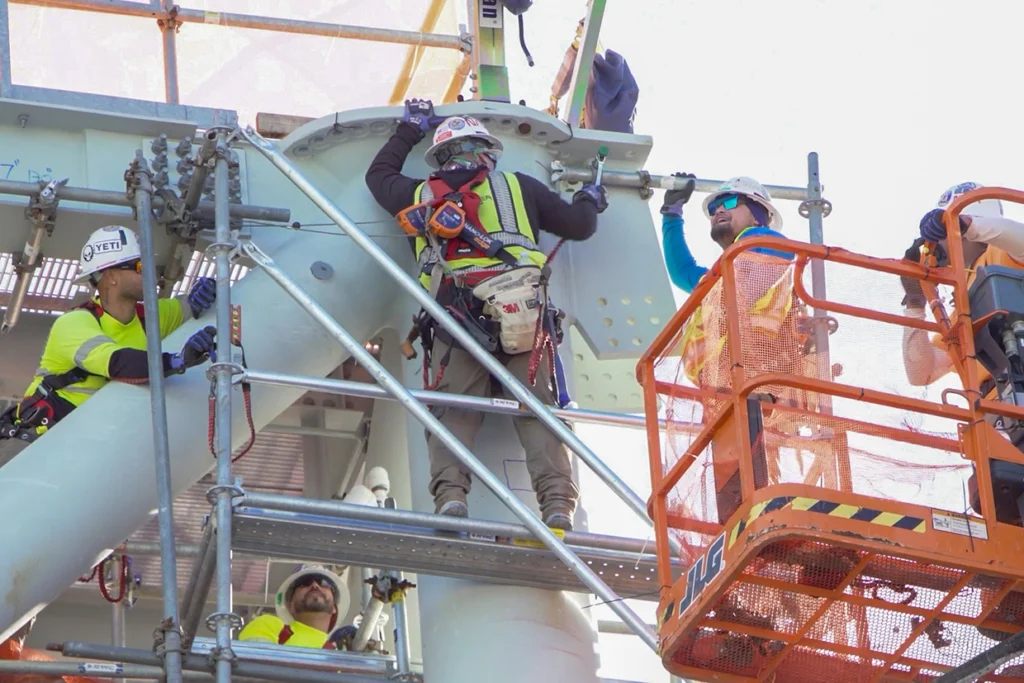
“The local got a project labor agreement,” said Nelson, who worked on the government contract for about nine years before becoming business manager in 2019. “We had contractors building it and a hundred-some people on it.”
At the same time, “our people were also over at 39B, running in new infrastructure and new communications and power systems,” Nelson said. “We pretty much tore the old pad down to the ground and rebuilt it.
“The majority of it has been union work, and the major electrical work was done by the IBEW,” he said.
It’s been the kind of high-quality work people expect from the IBEW.
“When Artemis I took off [in November 2022], I had guys send me pictures of stuff [on Mobile Launcher 1] that was blown out and destroyed,” he said. “Everything that we installed stayed.”
Jeff Henderson, who recently retired as an international representative with the IBEW’s Fifth District, was Local 756’s service rep.
“The success of that whole project, I believe, was thanks to Matt and his relationship with contractors and NASA,” Henderson said.
With NASA planning to send regular Artemis missions to land on the moon, Local 756 members in 2020 were tapped to work on a second mobile launcher.
“Getting everything set up, we peaked at 170 journeymen on first and second shift,” Nelson said. “They were working 10 hours six days a week, seven days at one point.”
To construct Mobile Launcher 2, NASA tried a different approach.
“This one, they built it in stages, most of it on the ground so people could work off lifts and booms,” he said. “Then, they put it together like Lincoln Logs or Tinkertoys.”
Most of the Local 756 members working on Mobile Launcher 2 were laid off in March when the project was placed on hold.
“They’re going to take it and re-engineer it,” Nelson said.
The business manager is confident that the space agency can make the launcher work.
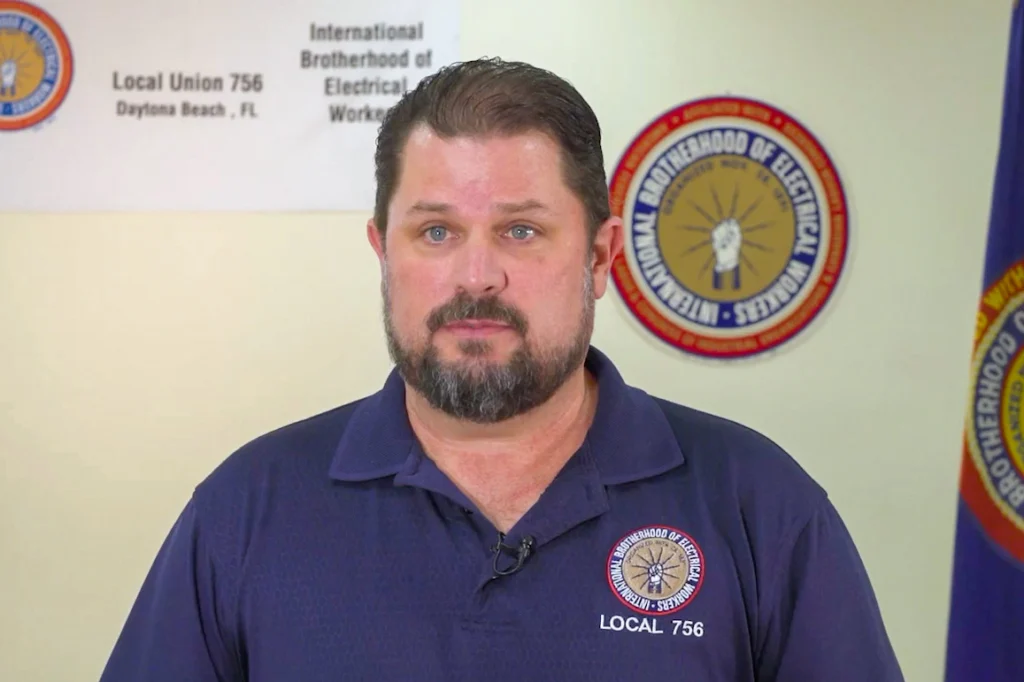
“… [T]he infrastructure — the launch control center, launch pads, mobile launchers — everything that gets the rocket to the pad — that’s us.”
– Local 756 Business Manager Matthew Nelson
“We’re trying to keep it our project because we have the guys that know how to do it,” Nelson said. “It’s like 60% done. They’re not going to trash it.”
He and other Local 756 members also have worked extensively in the VAB, which opened in 1966.
“I was there working for subcontractors when the shuttle was still active,” said Nelson, who’s been an IBEW member for nearly 30 years. “We had to modify the platforms and put new ones up.
“It had a glass elevator, so you could see the whole thing. It was just a neat experience,” he said.
Over in the Launch Control Center, “we got to redo some of the antiquated stuff in the room to get it up to date,” Nelson said.
The business manager estimates a need for at least 100 more electricians in the coming months to staff work for SpaceX, one of NASA’s commercial customers that leases Pad 39A for programs such as Starship, Falcon and Gigabay.
“There was a lot of animosity for years over SpaceX and Davis-Bacon,” said Henderson, referring to the law requiring payment of local prevailing wages on projects that receive federal funding. “When Matt came in [as business manager], he got it all squared away.”
Local 756 members also work on Cape Canaveral for Relativity, a 3D-printed reusable rocket startup, and for Blue Origin, which launches spacecraft from Pad 36.
“We’re pushing some of the nonunion contractors out of these space center projects, which is amazing to me,” Nelson said. “Blue Origin fired the nonunion contractors they’ve been using for years and hired one of our union contractors, because they’d seen our work.”
Henderson said Nelson’s experience has helped him make things work.
“Every place has its quirkiness about how to get things done,” he said. “Matt is excellent at that.”
Nelson is working hard to ensure his members have access to space-related construction and maintenance jobs for as long as possible.
“There’s so much work, there’s so much money, and so much potential,” he said. “This work is not going to go away.”