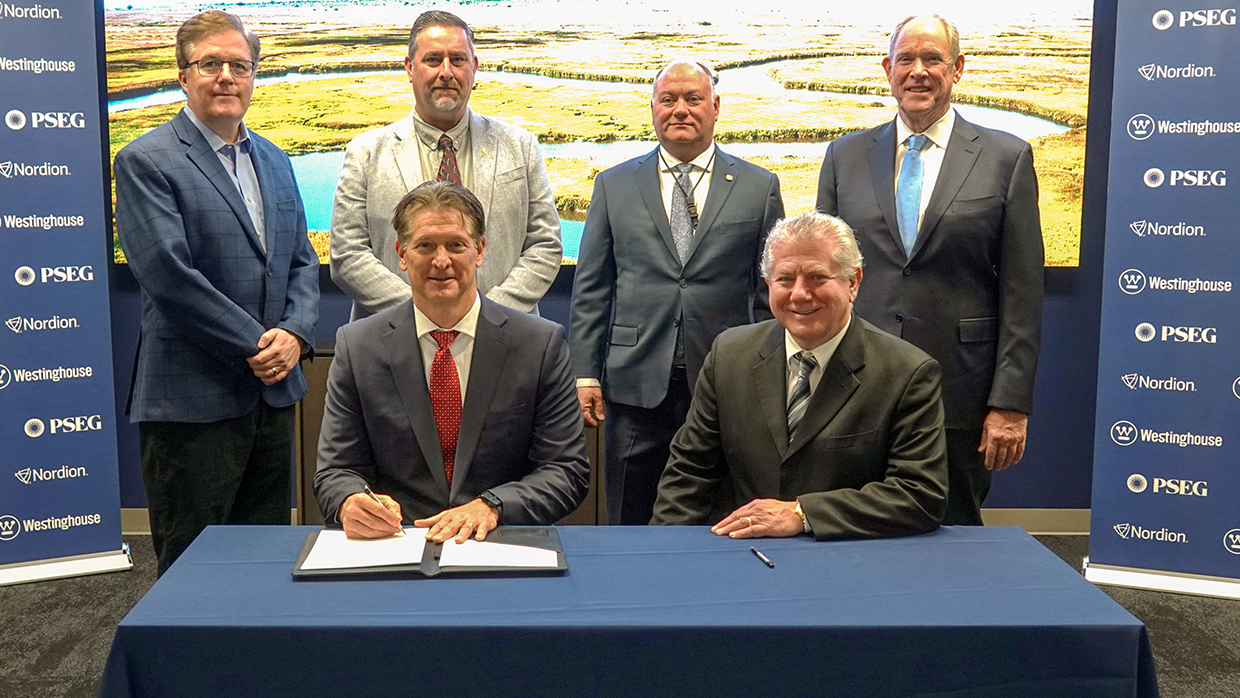
Nuclear power has been getting a second look as a clean and reliable energy source, with mothballed plants coming back online. In New Jersey, it’s also taking on a new role that will move production of an in-demand isotope to domestic shores and aid in cancer treatments — with Cranbury, N.J., Local 94 members at the helm.
“This is a huge step for the company and the union in demonstrating their commitment to not only providing safe, reliable and efficient power, but also showing the unlimited potential of nuclear to provide for the community and make lives better,” said Local 94 Business Manager Adam Neuman.
Members of Local 94, who work at the PSEG Salem nuclear generating station, will now be tasked with production of Cobalt-60, a radioisotope that is used to sterilize more than 16 billion single-use medical devices a year, including syringes, surgical gloves, catheters and heart valves. It’s also used in radiation therapy to treat certain types of cancer, and in precision brain tumor surgeries.
“Anytime we can take on work that is in demand and projected to be in place for several years, it shows commitment to the community and the workforce,” said Dave Scott, Local 94 nuclear business agent. “I believe that the more people hear about the benefits of nuclear energy, the better.”
One of the great features of the Cobalt-60 production evolution from a business standpoint is that there is very little added work to the normal refueling process, Scott said.
“This is a huge step for the company and the union … showing the unlimited potential of nuclear to provide for the community and make lives better.”
– Local 94 Business Manager Adam Neuman
Cobalt-60 is produced by placing naturally occurring Cobalt-59 into the reactor vessel fuel rod assemblies using a special encapsulated assembly called a cobalt burnable absorber. Once the reactor is placed back in service, a process known as “neutron bombardment” takes place where the Cobalt-59 absorbs the free neutrons, transforming it into a Cobalt-60 isotope. The process takes about three 18-month fuel cycles before the medical-grade isotope can be harvested.
Most of the 600-member Local 94 workforce is shared across the three-unit site and either participates directly in or supports the outage efforts, Scott said. The Local 94 members who would most directly participate in the process are the radiation protection technicians and operators, who would monitor and oversee all handling and transportation. Operations members may be involved with moving fuel after it’s placed in the spent fuel pool.
The Cobalt-60 endeavor comes from a partnership among Westinghouse Electric; Nordion, a Canadian company; and PSEG Nuclear. The project will result in the first commercial-scale production of Cobalt-60 in a U.S. nuclear reactor. Under the agreements, the companies are to apply newly developed production technology for pressurized water reactors.
The technology to produce Cobalt-60 has been trusted for nearly 70 years due to its deep penetration, uniform dose distribution and compatibility with a wide range of materials, Westinghouse said in a news release.
Despite its track record, the U.S. relies entirely on foreign sources for Cobalt-60, with 20% to 50% of supply coming from Russia. About 50% comes from Canada.
The new collaboration paves the way for 25% of the isotope to be made at the Salem plant.
“This advancement strengthens global supply and demonstrates how commercial nuclear energy can support critical healthcare infrastructure,” Sophie Lemaire, interim co-president of Westinghouse Nuclear Fuel, said in a news release.
Production of Cobalt-60 at commercial scale is made possible by tax credits in the Inflation Reduction Act, sweeping climate legislation that’s considered to be the largest in U.S. history. It was signed into law by President Joe Biden in 2022.