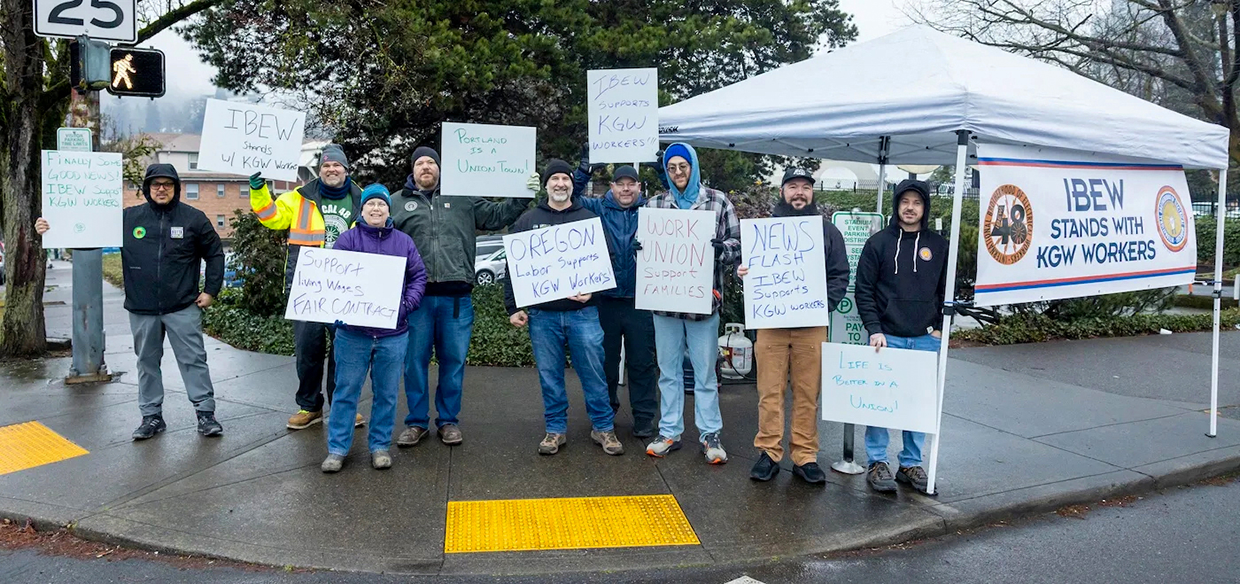
A group of TV and digital news producers who voted overwhelmingly to join Portland, Ore., Local 48 earlier this year is standing strong against their employer’s aggressive union-busting campaign and election challenges.
The organizing drive at KGW-TV was sparked a year ago by an existing unit of directors, who found themselves fighting for their jobs and jurisdiction as the company pushed automation and overlapped duties between union and nonunion employees.
“It’s just been in the last few years that the corporate mindset has changed, and honestly it’s been awful,” said a worker who misses past labor peace and management respect at the station.
“Now it’s, ‘Hey, we’re not making the record profits we used to, the industry is changing to digital,’ and all of that is a fact,” the worker said. “But there’s no shortage of corporate profit. They’re just gutting from the inside.”
The broadcaster began in radio in the 1920s, bills itself as “Portland’s leading local news” and is one of 64 stations owned by Tegna nationwide — a number that would skyrocket to 265 stations if the company is absorbed by media giant Nexstar. The $6.2 billion merger was approved in March but frozen by a federal judge in April after 13 states, including Oregon, filed an antitrust lawsuit.
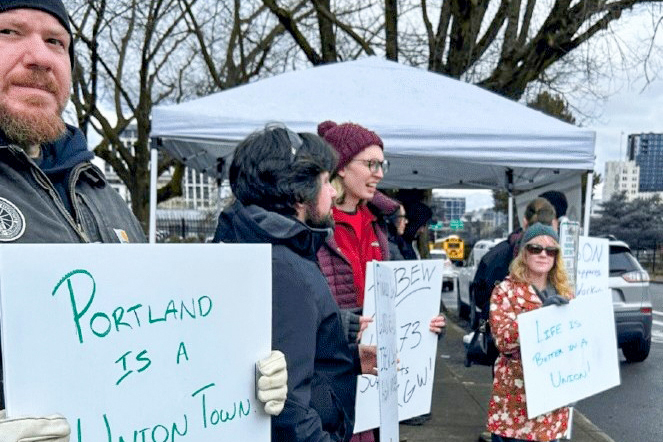
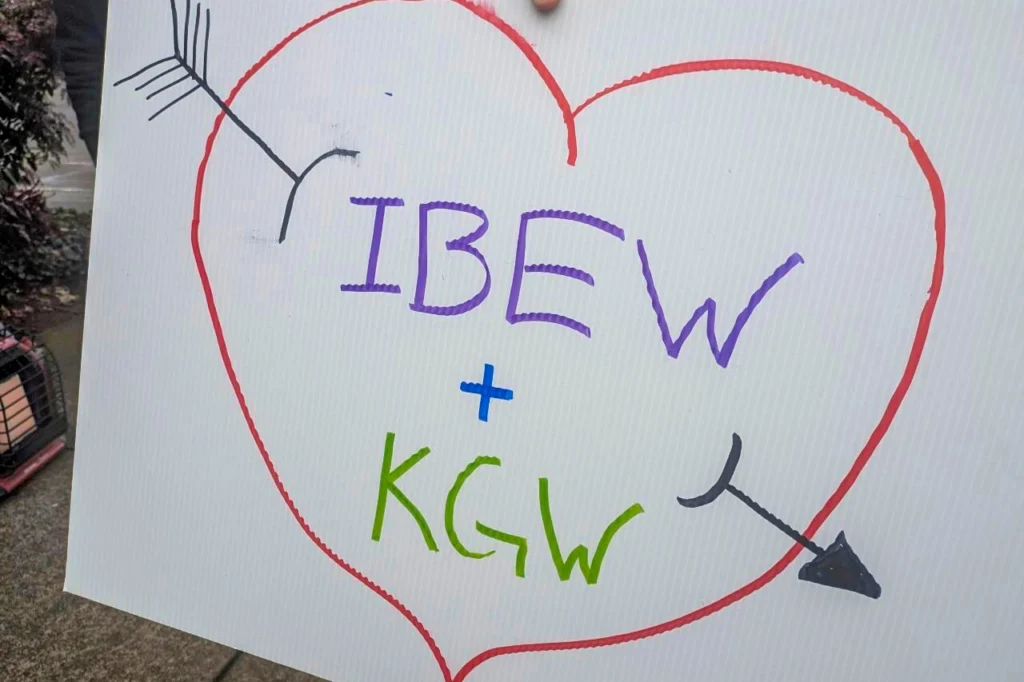
Unionized directors at KGW showed their love for their jobs, the IBEW and their worker-friendly city while greeting producers on Feb. 19, the day they voted to join Local 48’s existing unit at the station. Management refuses to recognize the new members.
Union-busting was central to Tegna’s playbook as it prepared for the merger, fueling a level of hostility from KGW management that surprised even veteran union staff. Local 48 Business Representative Tara McElligott, who came to the IBEW this year from the International Chemical Workers, called it “among the most relentless, cynical and sustained anti-union efforts I have witnessed in two decades of this work.”
Tactics included a blizzard of deceptive fliers, emails and other communication; “voluntary” anti-union meetings; letters hand-delivered to producers’ homes on the eve of the Feb. 19 election; and the startling presence of armed security guards when they arrived at a scantly staffed KGW the next morning.
“They claimed the union was going to be violent, so they told all the non-essential people not to come in on the day of the election,” said Mark Hinkle, another Local 48 business representative.
The union won 17-3, with all 20 eligible voters casting ballots. The company immediately filed objections with the National Labor Relations Board. It lost four out of five of them at the regional level. Tegna is appealing the losses to the full NLRB, which is also expected to hear arguments on the fifth charge.
Organizers were delighted by the landslide but not surprised, having seen the producers’ interest in the IBEW grow quickly after a union activist proposed the idea last summer.
“As that area between what the producers do and what the directors do got grayer, a union worker said, ‘You guys really should be part of us,’” Hinkle said. “And once that seed was planted, it only took a very short while.”
“Pizza in the park” gatherings across the street from the station in downtown Portland gave producers a chance to ask questions of directors and IBEW representatives. “The directors told the producers about their union experience: ‘This is how it’s been for us, these are the perks and protections, and we think you guys deserve them, too,’” Hinkle said.
On top of issues common to all workers, McElligott said, pay disparity was one of the motivating factors for producers, who are split almost evenly between men and women. In May, at the IBEW’s urging, Oregon’s Bureau of Labor and Industries began investigating KGW for potential wage discrimination.
One piece of evidence is a recording — made with permission of all parties — of a wrenching Feb. 2 meeting between two managers and an Emmy-winning woman producer being paid thousands of dollars less than some colleagues without the same longevity and duties. As she made her case for improving on the 2% merit raise she’d been receiving annually, the senior boss used the opportunity to pressure her to vote against the IBEW. Claiming the union would block merit pay, he repeatedly told her that 2% is “better than zero percent.”
“It’s heartbreaking the way that they treated her and it’s heartbreaking what she had to endure, but my God, did she stand up,” said Ray Lister, a Ninth District international representative and lead organizer.
McElligott said the woman “had asked repeatedly what the matrix is for merit pay and what she needed to do for earning more than 2% but was never answered.”
She added: “She was gaslit regarding her claim of pay discrimination and then was told by management that ‘We’re happy with where we are at in regard to pay.’”
Less than two months earlier, the company had no idea an organizing drive was underway. Other than the park meetings, workers largely connected using an encrypted app, Signal, keeping the campaign under wraps for six months. “The secret was kept tight. It didn’t leak out,” Hinkle said. “And that’s all on the producers.”
Lister was impressed by how well the group communicated with each other and the “phenomenal questions” they asked at meetings. “I can’t say enough good things,” he said. “There was so much active participation. Some organizing drives, it’s mainly a couple of people, but this time there was a ton of them. It’s easy to build trust when people are willing to communicate like that.”
IBEW negotiators dropped the campaign bombshell at a December 2025 bargaining session for the directors’ contract, stunning Tegna with a packet of signed cards from a majority of producers seeking representation.
Hinkle said bargaining had hit a wall that day and the company lawyer wanted to adjourn. But first he asked if there was any other business. “We said: ‘Yeah, one more thing. We have paperwork here that says we plan to umbrella in the producers.’
“We passed it over to management and asked them to voluntarily recognize the producers, and the look on their faces was shock and awe,” he said. “My joke is that you’d have thought it was holy water with garlic and silver nitrate. Their lawyer recoiled from it. He said: ‘We categorically deny this. I’m not even going to entertain the idea,’ and then he stormed out of the room, followed by the news director and a woman from human resources. We left it on the table, and they overnighted it back to us unopened.”
Hinkle believes management was especially angry because the IBEW’s revelation disrupted a merger-friendly scheme to get rid of the directors and their contract by shifting the work to nonunion producers. “I really think that was their long-term goal, and then they were like, ‘Oh, crap.’”
Workers said all that employees want is to be treated fairly. “As a news organization, we cover other people’s union efforts all the time — stories about people who deserve better, and now that’s happening here,” one said.
“I wish management understood that all the shady stuff they’re doing is 100% backfiring. I liked working here. I liked my managers. Now I’m disgruntled, and I don’t want to be. None of us here wants to feel that way.”