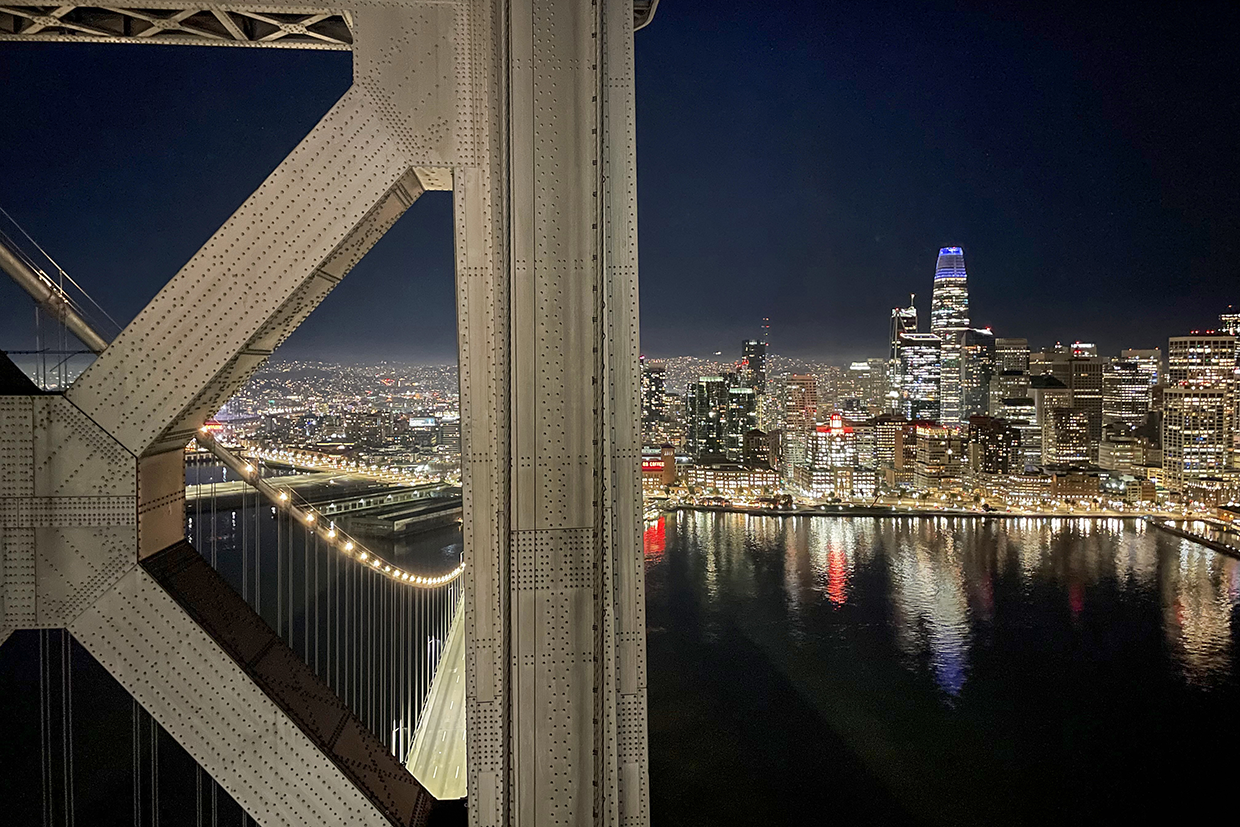
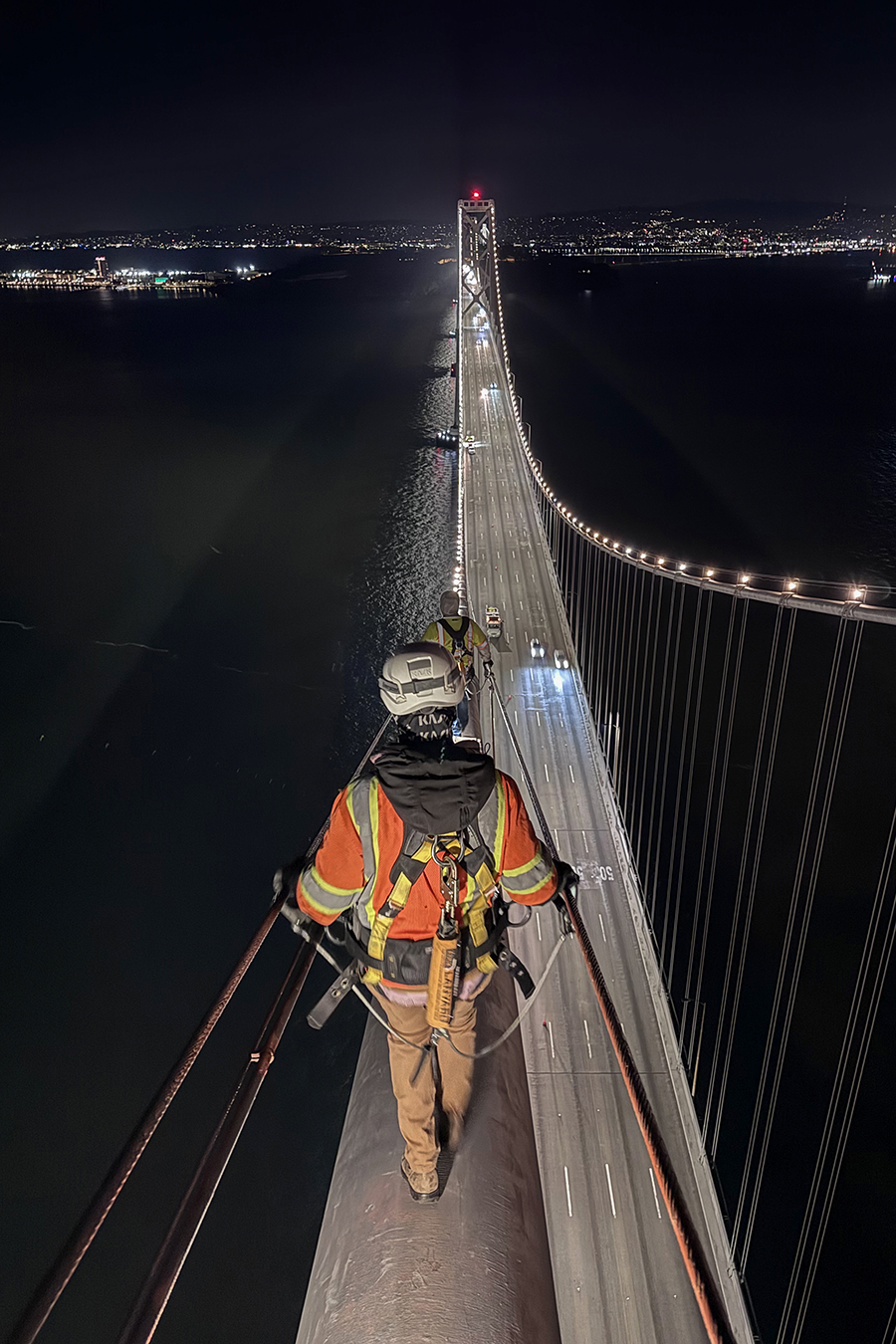
Photos courtesy of journeyman wireman Megan Dunlap
Thirteen years ago, the Bay Area’s second-most-famous bridge took the spotlight away from the Golden Gate Bridge.
The world’s largest light sculpture was installed on its western span by members of San Francisco Local 6 in 2013, and — maybe for the first time since the two bridges opened in 1938 — the humbler, busier Bay Bridge shone brightest.
Local 6 members hung more than 25,000 LEDs from 300 support cables. Together, the lights created psychedelic wave of flows and patterns that could be seen for miles.
But the lights eventually went dark. Caltrans, the owner of the bridge, only permitted the project for two years, and new, more permanent lights followed. The flowing waves of glowing bulges and flickers danced on the Bay Bridge until 2023.
The uniquely corrosive environment of the San Francisco Bay’s ceaseless sun, vibration from the gales above, rumbling cars and trucks below, and the salt-drenched mist slowly dimmed, decayed and then killed the Bay Lights after 10 years.
But some ideas aren’t meant to stay dark.
After 18 months of fundraising, a new, bigger, brighter, sturdier Bay Lights was announced, this time with nearly double the lights — 46,000 instead of 25,000.
One thing that wouldn’t change is who would do the work: Local 6.
“I’m from San Francisco. I was born in SF General, raised in Chinatown, and I live in the Outer Sunset [a neighborhood close to the beach], and this was the dopest job I’ve ever done,” said journeyman Saepate Vasa, who has been a member of Local 6 since organizing in 2018. “We have the purest bragging rights. How many Bay Bridges are there? One. I did that.”
Each night, Vasa and a crew of at least eight other journeymen would wait while Caltrans closed the northernmost lane of the bridge’s upper deck. Their shift started at 8:30 p.m. and ended at 4:30 a.m.
“We worked the graveyard,” said journeyman Megan Dunlop, who topped out of the Local 6 apprenticeship in 2020.
Nothing could be left on the bridge, so they staged everything each night they worked. The Bay Bridge is a suspension bridge. Support cables hang down in groups of four, arranged in a square. The electricians worked from a platform that fit inside the four cables. Each night, ironworkers climbed to the top of the bridge and attached a winch and cable to the gracefully arcing main cable. Laborers attached the cable to the platform, and up they went each night.
“It was like a window washer’s swing stage, but for one person,” Dunlap said.
The first nights were demolition. They attached tens of thousands of clips, held on with three pre-installed industrial-strength zip ties, and finally they hung the unbroken strands of LED lights. The longest cables rise 240 feet above the road, almost 600 feet above the churning waters of the Bay. The shortest span is only two feet long.
“We took up a huge empty canvas bag for the demo and a huge full bag when we were hanging the lights,” Dunlap said. “It was so heavy it took two people to lift it, and the whole platform tilted.”
Both Vasa and Dunlap recalled the fear in the first days on the job.
“For the first two weeks, I questioned why I took the job. That’s how afraid I was. I really hoped I wouldn’t embarrass myself,” Dunlap said. Especially frightening for Dunlap was terminating the strands. For that, they skipped the platform, clipped in, and climbed over the wall at the edge of the road.
For Vasa, the cherry pickers they used on the shorter cables were somehow more nerve-racking than jumping over the side of the bridge.
“Way scarier,” he said.
But after the first few nights, any fear fell away, and they were left with, in Dunlap’s words, exhilaration.
“There was an adjustment period, and the work was repetitive, but the experience made the repetitiveness not even matter. We saw the moon every night, and the view was amazing. Once you are up in the top, you feel like you are in a different place. It wasn’t ever quiet, but you were removed,” she said.
For Vasa, as the height faded into the background, working graveyard took its toll. But like Dunlap, the reward was being someplace extraordinary.
“The craziest part is you get to a certain height, and you hear nothing. You can see your boy over on that cable, but not close enough to talk to, and the cars look so far away,” Vasa said. “You have your work and the water and the city, and it’s something few people will see in a place few people will ever go.” Bay Lights relaunched March 20, a few weeks after Dunlap was laid off from the job. She’s doing service work now on a project where she can always look up and see the bridge.
“I feel so privileged and grateful. It’s hard to put into words,” she said. “When I show people pictures, they say, ‘This doesn’t look real.’ But I promise, this is real.”