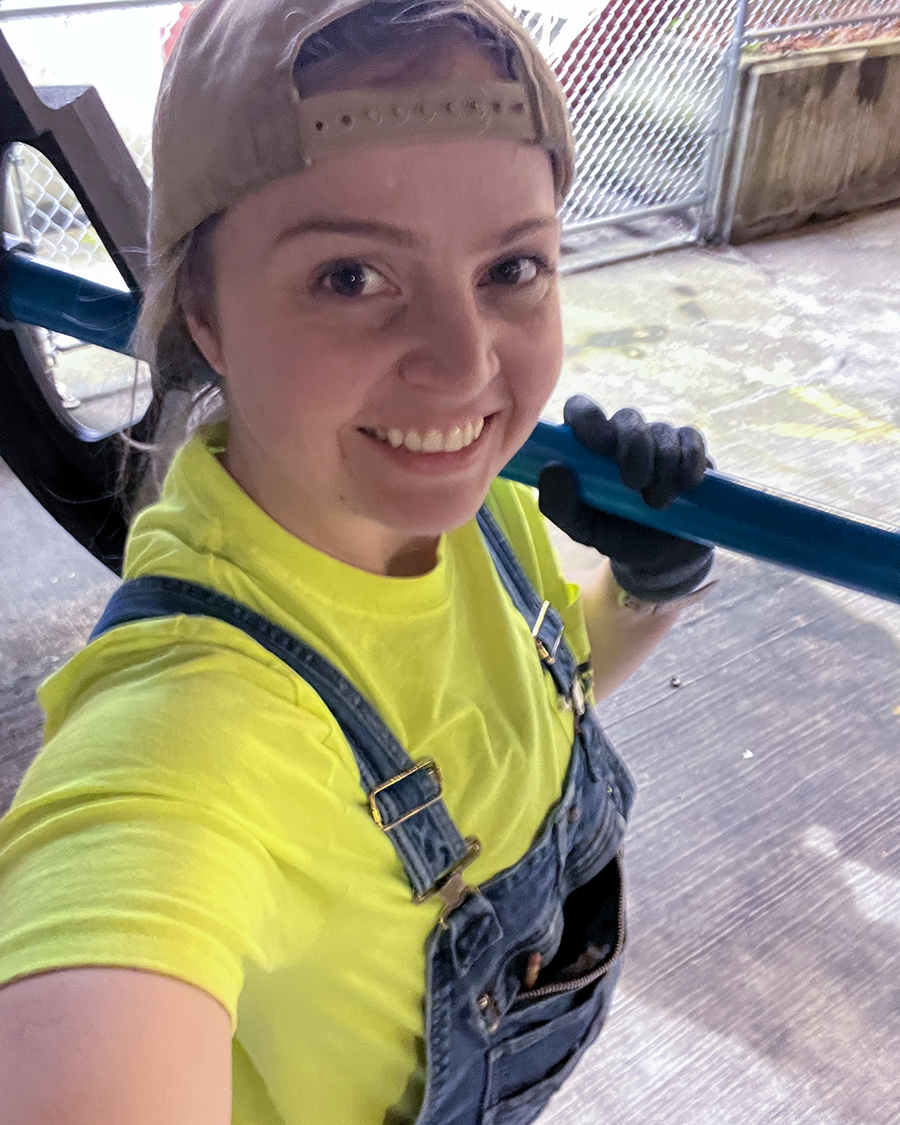
“The IBEW found me at exactly the right time.
I was a stay-at-home mom, ready for something more. I’d worked enough low-paying desk jobs to know I wanted a real career — something I could grow in and retire from. I was willing to work hard for it.
Growing up, I’d tag along with my dad on his handyman jobs. Sometimes I helped, sometimes I just watched — but I loved it. Being around the tools, working with my hands, feeling capable. That stuck with me.
While seeking out a career, electrical work stood out right away. It felt like something I could do for life. When I started researching, I found that the union accepted applications year-round — unlike nonunion. So I went for it. The only hiccup? My high school had shut down, and I had no official diploma record. At 30, I found myself studying for my GED — but honestly, that just confirmed that I was all in.
At an electrical job fair, I learned that the University of Oregon’s Hayward Field needed material handlers. I signed the books at Local 280 as a material handler and followed up by dropping off my resume at EC Electric and OEG. Within three months, I was on the job.
Hayward Field felt like Disneyland for construction — huge, exciting, and full of opportunity. I interviewed dozens of electricians: “Do you like this work? Could I do this?” Every single one encouraged me.
Then COVID hit. I was furloughed in March 2020, right as things were lining up — GED done, recommendations in hand, waiting on my interview. When it finally happened, it was the best interview I’d ever had. I got ranked No. 1 in August … but had to wait nearly a year to actually start because of the backlog. In July 2021, I finally became an apprentice.
By 2023, I was in service, working on great jobs and training for the Hood to Coast relay race. But something felt off. I was in marathon shape — or should’ve been — but everything felt harder. That led me back to my heart.
After some testing, I found out that the bicuspid aortic valve that I was born with was failing. Then things moved fast. A surgeon reviewed my case, and within a week, I was scheduled for open heart surgery.
That’s when the IBEW really showed up for me.
People brought meals. They checked in. They passed the hat to help me out. I had a whole community behind me at a time when I couldn’t even open a pill bottle on my own.
This career gave me more than a job — it gave me a future, a purpose, and a family that carried me when I needed it most.
And that’s something I’ll never forget. I am so thankful for my IBEW family.”