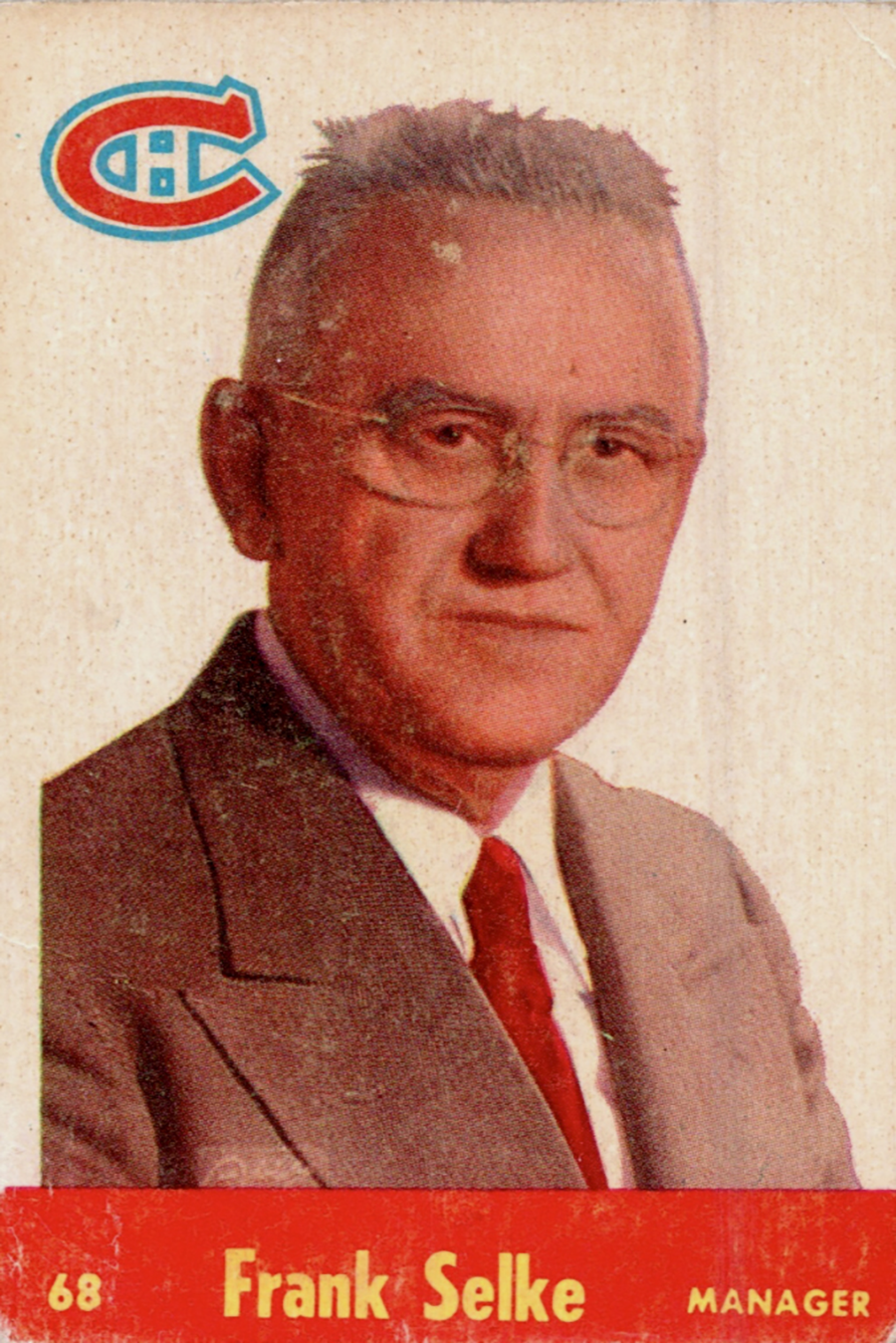
Frank Selke won nine Stanley Cups during a storied career managing Canadian hockey teams. But he was equally proud of the IBEW card he carried for more than 50 years.
His legacy lives on in both worlds, honored in the National Hockey League with a trophy named for him and celebrated in the annals of Toronto Local 353 as a strategic business manager who shepherded the local through the early years of the Great Depression.
Born in what’s now Kitchener, Ontario, in 1893, Selke was managing his hometown’s hockey team by the time he was 13 years old. He moved on to coach in the Ontario Hockey League and, after serving in World War I, led a University of Toronto team to a national title in 1919.
Brother Selke joined Local 353 in November 1925 and took on the role of press secretary, extolling the growing local’s many achievements in the pages of The Electrical Worker.
In February 1929, he wrote that the electrical trade “was booming” in Toronto and that “all members are contentedly employed,” reporting on a three-year agreement that brought the wage rate to $1.35 an hour in the third year. Meanwhile, he said, “the boys were knocking down $1.10 an hour, with lots of overtime.”
All in Good Fun
Frank Selke was known for his sense of humor, which he employed at times in his missives to The Electrical Worker. The anniversary book cited his reports on some early 1929 festivities, noting that he “couldn’t help but tweak the noses of his union brothers in the United States” about Prohibition, the 13-year stretch from 1920 to 1933 when the 18th Amendment outlawed alcohol.
Sharing the details of a social that Local 353 members attended at Hamilton, Ontario, Local 105, he wrote, “[S]uffice it to say that the working parts of the boys were ‘well oiled’ and everyone joined in with enough whoopee to make it a memorable evening for all.” When Toronto members returned the favor and invited Local 105 to a social, they teasingly expressed regret that “the parched boys south of the border” couldn’t join them.
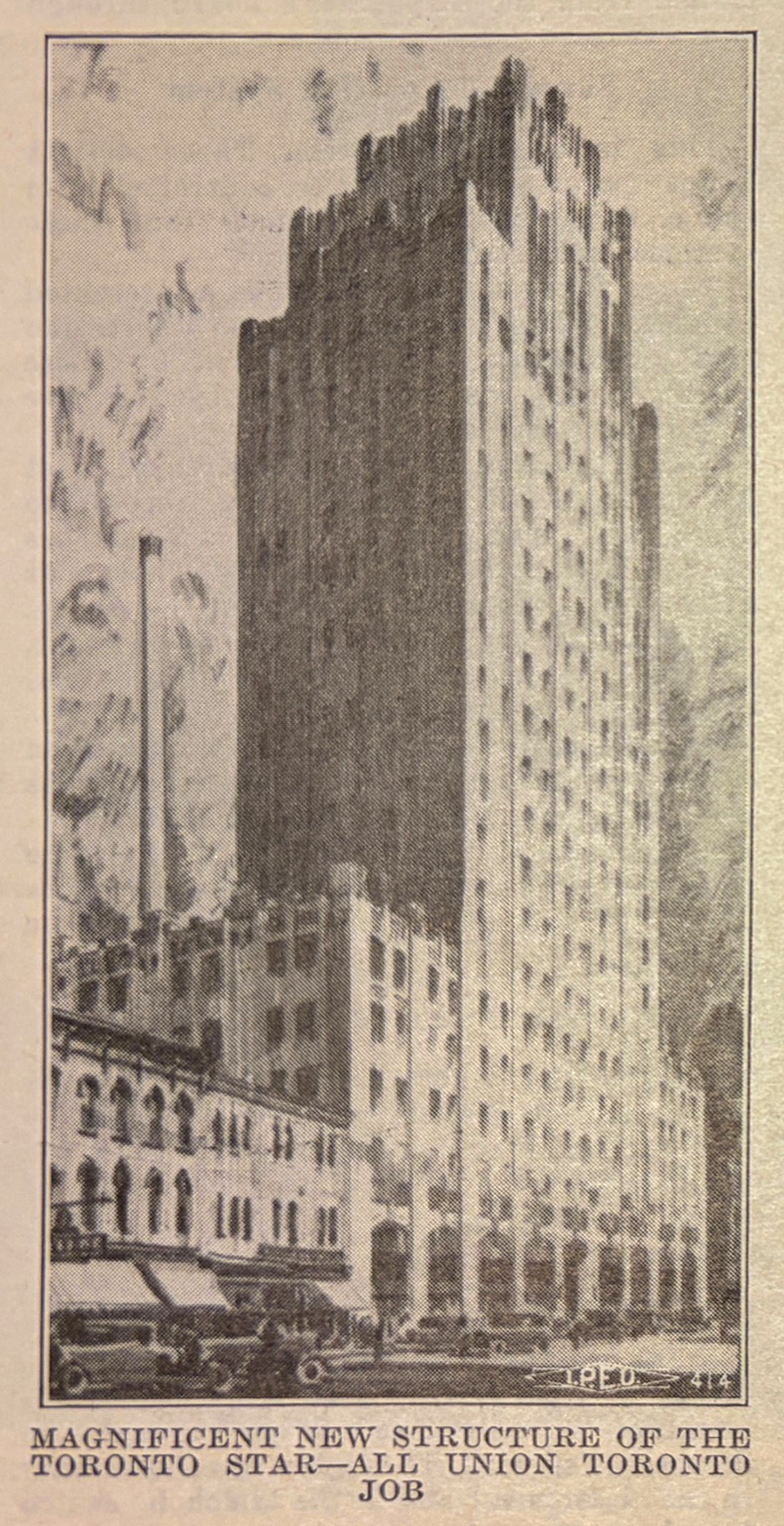
Selke beamed with IBEW pride in his press reports, as when he heralded two of Toronto’s major projects in 1929. One was the Daily Star headquarters — a 100% union-built art deco palace considered one of Canada’s finest buildings and later used as the model for Superman’s Daily Planet. The other was the Royal York Hotel, which he called “the largest and finest hotel in the British Empire, and in the writer’s humble opinion has few equals anywhere on earth.”
“Not one iota of electrical work in this building was done by any but loyal members of the International Brotherhood of Electrical Workers,” he wrote. “Five tons of copper buss bar were used in the erection of the switchboard. One hundred and fifty miles of rigid conduit of various sizes were installed in the job. Three thousand four hundred outlets are situated in the structure, 1,300 of these being fixtures also installed by Class ‘A’ men of our local. One hundred and fifty thousand feet of telephone wire and 6,000 feet of signal cable were used in the room to room connections and so on.”
The projects fueled a feeling of optimism in early 1929, as the local’s history-packed 100th-anniversary book noted in 2003. No one could have imagined the catastrophic stock market crash that would turn their worlds upside down that October.
At the time, Selke had been doing triple duty for more than a year. He was the publicity director for Maple Leaf Gardens, home of Toronto’s hockey team, while also coaching a minor-league team.
Yet he continued on as Local 353’s press secretary and then as business manager — a job he performed without pay from 1930 to 1932, when he launched his full-time hockey career.
Selke was determined to preserve members’ morale even as jobs began to disappear, and he fervently believed in the power of the union to make their lives better, no matter how tough the times.
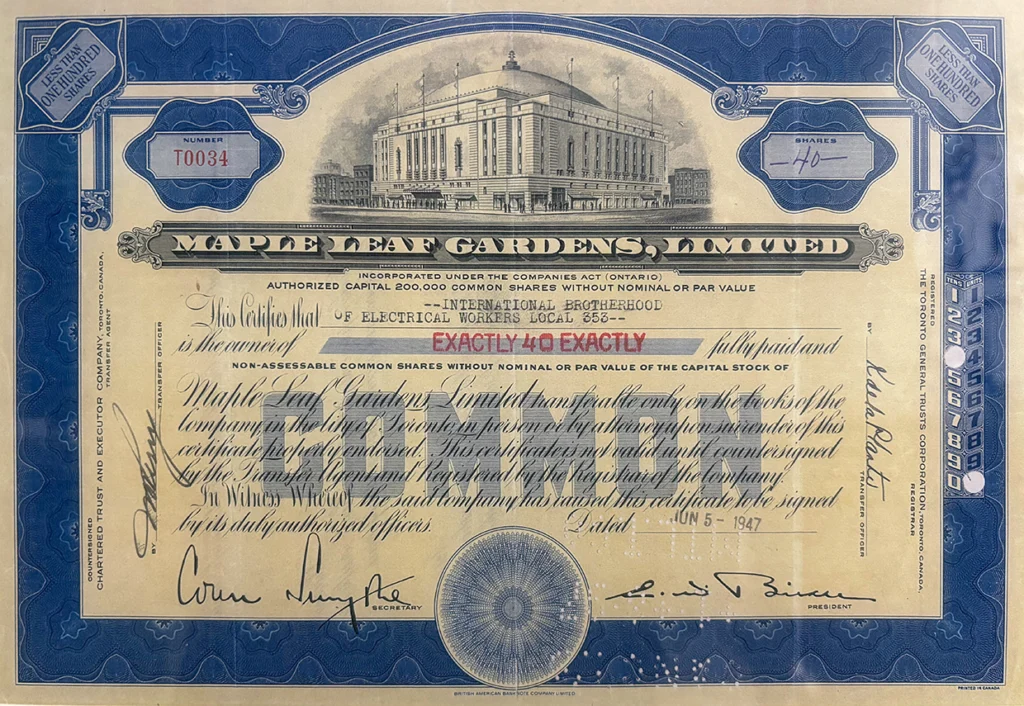
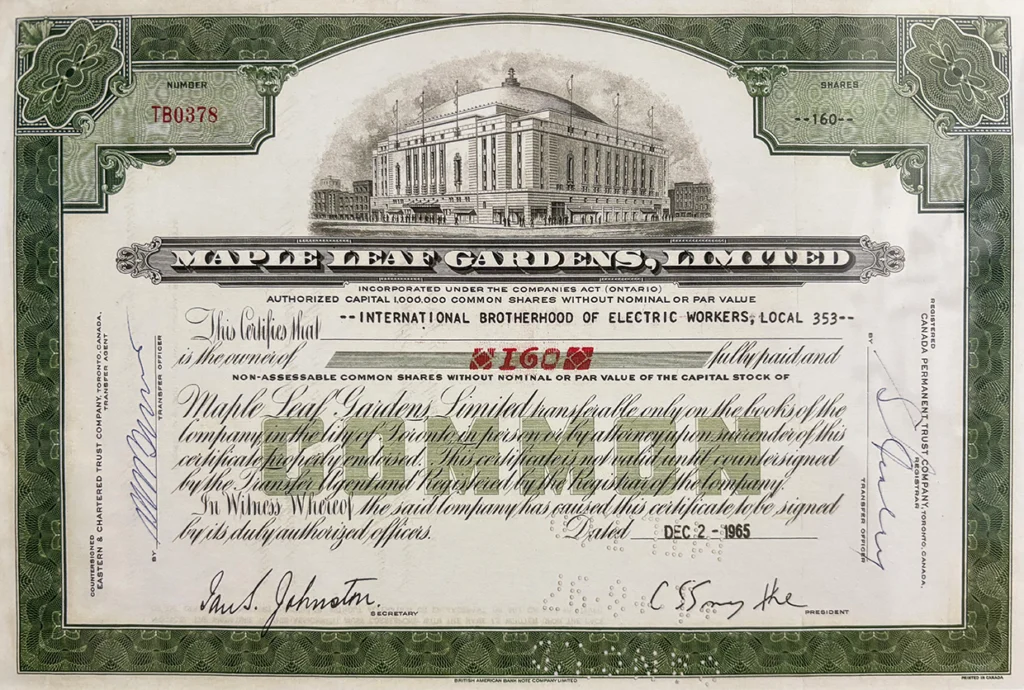
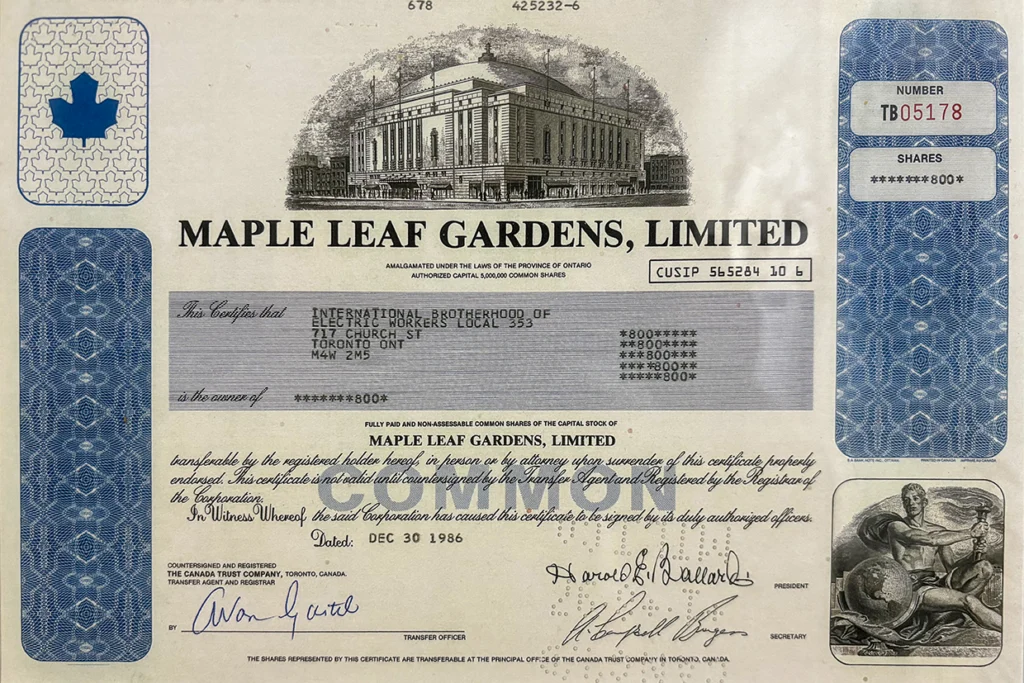
Stock certificates for the Maple Leafs organization, which built a new arena in 1931. To win the contract, Local 353 and fellow trades agreed to take 20% of their pay in stock.
“All the good things we have ever received, boys, have come to us through the efforts of the local union,” he said, “so don’t let any individual, with an axe to grind or personal ends to meet, convince you that there are other and better ways of improving your economic position than through your local union.”
But he also understood the despair as the hard months dragged on. “They tell me the boys here had a real hot meeting while I was away,” Selke wrote in April 1931. “Veiled threats and what not floated through the air for several hours, with the result that everyone unloaded a lot of cantankerous matter off their chests, then finally decided we were all good fellows and surely the local is none the worse as a result of this more thorough understanding of ideals.”
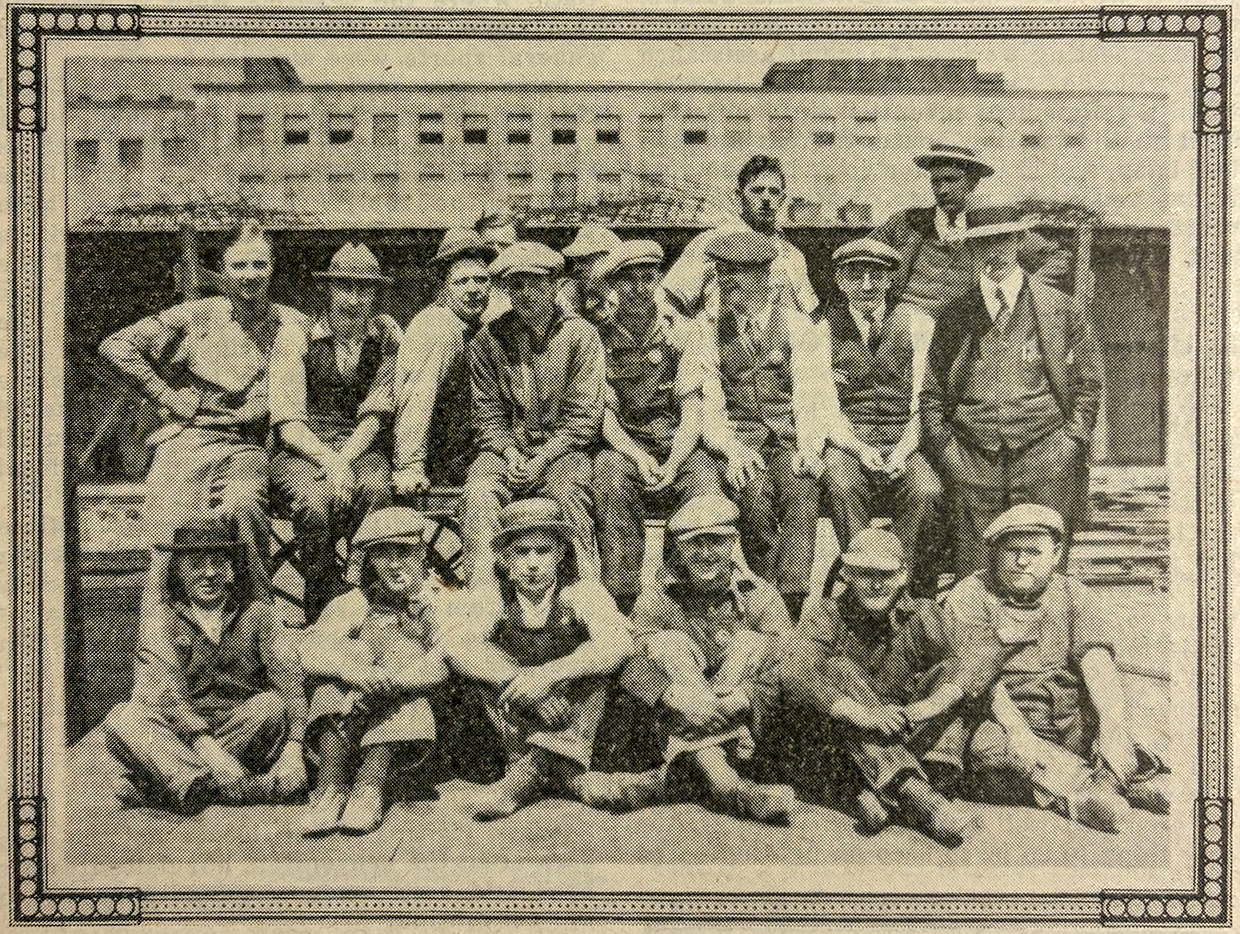
Not all work dried up. A Campbell’s Soup plant was under construction, and a new arena for the Maple Leafs was on the drawing board. A deal was struck with the team’s owner to use only union labor as long as the workers would take 20% of their pay in Maple Leafs stock. It appears to have paid off: In 1932, the team won the Stanley Cup.
“Proudly, our first office was through a small door, on the second floor, on the east side of the original Maple Leafs building,” Local 353 Business Manager Lee Caprio said. “Under Frank’s leadership as business manager, our local and other trades agreed to coordinated scheduling, standardized wage arrangements and shares. The inaugural game was played on November 12, 1931, only five months after construction began. We still have the shares displayed at our hall.”
It was a shot in the arm for the local. In January 1931, Selke reported that 200 journeymen were out of work and another 200 were working less than half time. But, typical of him, he remained hopeful: “In spite of it all, we have lost only a few members and if we can weather the storm until the new jobs open, Local Union 353 will have emblazoned itself in such a manner that it will live a long time in Toronto’s civic history.”
The anniversary book noted that Selke fought for the local on multiple fronts, criticizing municipal, provincial and federal politicians, as well as the corporate community, for having cold feet.
“As far as Selke was concerned, all that was required of these leaders was to provide plenty of work at good wages for the eight-hour-per-day boys and the rest would look after itself. With steady work, the working man would have the resources to embark on a spending spree that would not only improve his morale but would improve the economy as well.”
Selke’s career in hockey took him to remarkable heights, first leading the Maple Leafs to three Stanley Cups, then moving to the Montreal Canadiens in 1946 and winning another six. He is credited with creating a farm system for the NHL, proposing in 1946 that the league sponsor junior teams. He was elected to the Hockey Hall of Fame in 1960, and in 1978, the NHL began awarding the Frank J. Selke Trophy, which honors each year’s best defensive forward.
Through it all, Brother Selke never gave up his Local 353 membership. When he was presented with his 50-year pin in 1975, according to the anniversary book, “he said he regarded his union card as one of his proudest possessions.”
Visit nbew-ibewmuseum.org for more on how to support the IBEW’s preservation of its history. Have a an idea for this feature? Send it to [email protected].