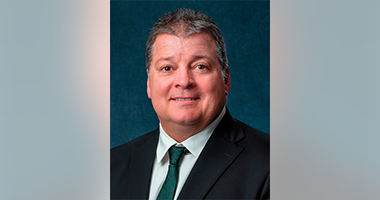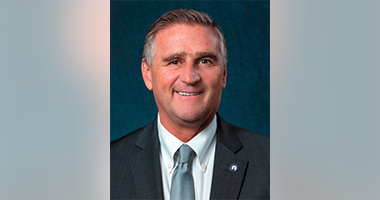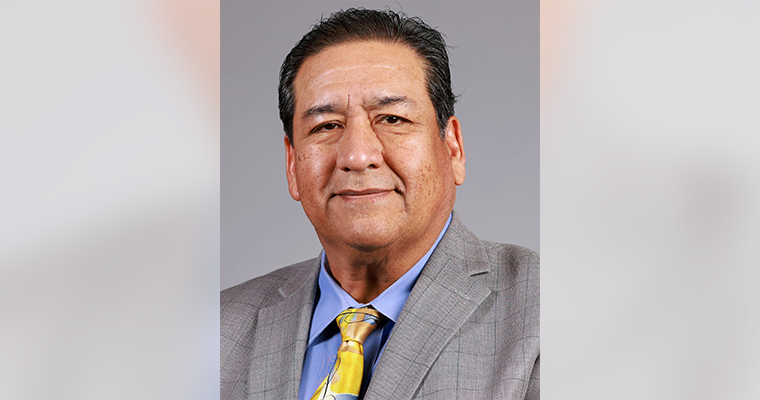

RETIRED — Jeff Henderson, Fifth District international representative and one of the first international organizers hired by the modern IBEW, retired May 1. Henderson was one of former International President Edwin D. Hill’s first hires in his project to standardize composite crews and alternate classifications across the IBEW, originally called the Florida Initiative.
Henderson topped out of the Gainesville, Fla., Local 1205 apprenticeship in 1989, and quickly started running work.
“The owner took me under his wing, really showed me the ropes: estimating, bonding, running work. If I’d had any sense, I would have gone on the road and made real money, but I stayed and was never laid off,” Henderson said with a laugh.
For a year, Henderson even ran his own shop, until a company he worked for stiffed him on a job and left him with “$100 and a pickup truck.”
That experience left Henderson with an invaluable understanding of a contractor’s life, said fellow Fifth District International Representative Matt Meadows.
“He was better than anyone at top-down organizing. When he talked to them, they knew he understood bid processes and how costs are calculated. He had their respect and their attentions,” Meadows said.
Henderson said it was less about what he said than about listening.
“On the inside, mostly we show up and say, ‘I’m the best there is,’ and you get paid. We have no idea what that employer goes through,” he said. “I understood what they are going through. Basically, I knew enough about labor and knew enough about contracting that I could make it all mesh.”
After the collapse of his business, Henderson helped Business Manager Harold Higginbotham open an apprenticeship program in Tallahassee, working as a superintendent during the day and teaching at night.
“The most important thing for the future of this union was and is market share.”
– Fifth District International Representative Jeff Henderson
The project was such a success that when Higginbotham was appointed international representative in 1999, Lanny Mathis — then the local’s president and now business manager — approached Henderson about finishing the term.
It wasn’t a simple call.
The IBEW, he saw, was in deep danger.
“I did an Excel worksheet with the age of the journeymen, how many apprentices we had, our market share, and what it would take to stay at the same level. You started doing the math, and it was eye-opening. There is no way we would have survived. We would not have survived,” he said.
Locals everywhere had ways to help signatory contractors compete. But, Henderson said, too often the plans involved winning short-term victories that made long-term loss more likely.
“We all had ‘bottom drawer’ agreements, all across the South, agreements we didn’t send to the IO for approval. We had ‘commercial’ and ‘residential’ journeymen, ‘A’ and ‘B’ insurance, ‘A’ and ‘B’ pension contributions, different wages,” he said. “Some people called them VDV, some locals called them cable pullers, we called them groundmen. We’d always had composite crews, but it was composite at the journeyman level.
Soon after he ran for reelection for the first time in 2001, a new and powerful ally showed up in the fight to reverse the Brotherhood’s decline: President Edwin D. Hill.
“When Ed found out about those bottom-drawer agreements, he knew something maybe other people had forgotten. Lying to other people is bad. When you start lying to yourself, that’s when you get into the deep, deep trouble,” Henderson said.
Henderson said Hill told the Florida business managers that there was going to be a mandatory meeting.
Hill, Henderson said, told the room they needed a plan to end bottom-drawer agreements and, most importantly, stop the erosion of market share.
“That was what Ed understood better than anyone. The most important thing for the future of this union was and is market share,” Henderson said.
Henderson was tasked with writing up the plan.
The result, which made the inside journeyman sacrosanct again and created the CE/CW classifications, became known as the Florida Initiative.
Henderson ran for and won reelection a second time in 2004, around the same time the Florida Initiative was getting off the ground. In 2006, Hill hired Henderson to become one of the first international organizers, along with Jeff Rose in Iowa and Dwayne Moore from California.
His first assignment was bringing the Florida Initiative to Georgia and then the rest of the South.
In 2010, Higginbotham retired as an international representative, and, once again, Henderson followed him.
For the next 16 years, Henderson was a service rep across the Southeast, working with local unions representing every classification in the Brotherhood.
The one job that was most difficult and most rewarding, he said, was chartering San Juan, Puerto Rico, Local 787 with fellow International Representative Lorraine Llauger and former Fifth District International Vice President Brian Thompson, who died in November.
“He was a good tool buddy. I miss him,” Henderson said of Thompson.
Henderson said building the relationship with new members and a new employer brought him back to the earliest days as a top-down organizer. There were people on all sides who were pushing for confrontations with Luma, the newly formed utility in Puerto Rico. But Henderson said he carved out a productive relationship with the head of HR, and after some growing pains, Local 787 found a leadership core that will work hard for the membership.
“I’d never chartered a local before. I had to dig deep on everything I knew for that one,” he said.
When he thinks about how many locals we have amalgamated, how many members we’ve lost, Henderson said, seeing the local sign its first contract and moving from strength to strength was a real high for him.
“It was probably 30% skill and 70% luck, but I think everything is good now,” he said.
The officers and members of the IBEW express our gratitude to Brother Henderson for his dedicated service and wish him the best that retirement has to offer.