

Throughout the 100-plus years of Local 569’s history, the local has proven itself to be a formidable union and an integral part of San Diego.
Throughout its history, San Diego Local 569 has persevered and thrived through the changing political and cultural dynamics of a city that was once anti-labor to one that fights for — and wins — pro‑worker protections.
“Local 569’s history shows what can happen when a union stays engaged in the communities where its members live and work,” said Ninth District International Vice President Dave Reaves. “Years ago, the local recognized that if we weren’t part of the conversation, others would be making decisions that directly affected our members, our industry and our future.”
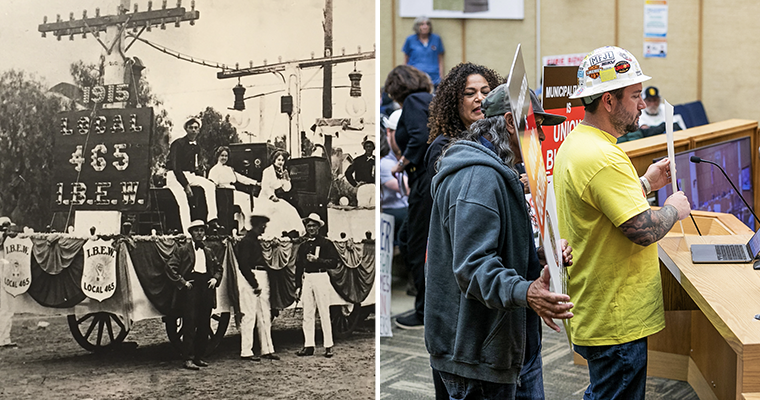
The story of Local 569 begins with San Diego Local 465. Chartered in 1904, the lineman’s local was the original home of the growing population of wiremen, then called “inside men.” By 1920, Local 569 had received its own charter.
The union enjoyed early successes, including a commitment from area contractors to establish a five-day workweek for its initial 125 members. The early years also saw the emergence of the local’s political acumen. In coordination with a city-wide labor committee, Local 569 joined the organized labor effort to send a union man to the San Diego City Council.
With San Diego’s promise of beautiful year-round weather and picture-perfect landscapes, the town attracted a number of union and nonunion electrical workers in the winters. The worst among the lot, according to the local’s historical record, were the “skates,” IBEW members from other locals who came to town and “hid their union ticket in their shoe” so they could work nonunion without reporting to the local.
The 1930s was an era of expansion for Local 569. By that time, it had unionized 95% of the area’s wiremen and amended its charter to include organizing other workers in the electrical trade.
Alongside the suffering of the Great Depression, the decade also saw landmark pro-worker legislation enacted, including the Wagner Act which gave private-sector workers the right to form a union and mandated that the employer bargain in good faith, among many other provisions.
The following decade’s work picture was boosted by World War II, which greatly impacted San Diego, by then a Navy town. As Local 569’s historical document put it, “There was a job for both Rosie the Riveter and GI Joe.”
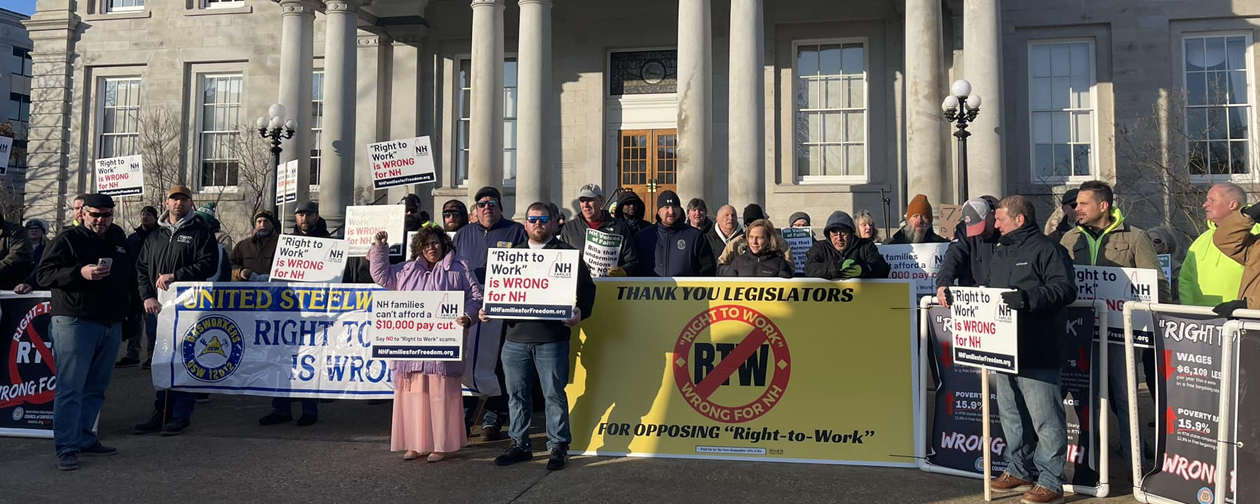
As the world and the city were recovering, Congress passed sweeping anti-union legislation known as the Taft-Hartley Act. The law gutted major portions of the Wagner Act and gave rise to so-called right-to-work laws, which allow workers to opt out of paying dues despite being protected by the union.
The Korean War of the 1950s yielded full employment for years, before mass layoffs closed out the decade.
Despite the setbacks, Local 569 grew in numbers and strength, and as it did so, it turned to other ways to support its members. This included a women’s auxiliary and the establishment of an employer-sponsored health and welfare plan. It was also the first West Coast local to offer a pension to its members.

Despite the remarkable progress that Local 569 and other locals made for their members, San Diego remained an anti-union Republican stronghold. But starting about 20 to 30 years ago, changes in the demographic makeup of the city began to favor pro-union politics, and this, coupled with a more politically savvy and strategic labor movement, signaled that the tide was changing to favor the working class.
“We had to get rid of a good old boys’ club,” said Local 569 Business Manager Jeremy Abrams. “When the Republicans owned the city and county, they took away pensions from county workers. It was a free-for-all. But because of the work we’ve done over the years with the Labor Council and Building Trades, we were able to raise the bar for workers.”
The exact moment when San Diego’s political climate swung is difficult to pin down. Greg Moran and Cody Dulaney, writing for inewsource, a local publication, contend that the power shift began around 1998 with a labor-backed proposition to repair San Diego schools. Then in 2004, the unions, including the San Diego and Imperial Counties Labor Council, backed a mayoral candidate who didn’t win but came close enough to startle the establishment.
“That is when labor really got engaged,” San Diego political consultant Tom Shepard told inewsource. “That was the first time I remember some different unions spending a lot of money to the point where it was a much more level playing field than it had been in the years before that.”
By 2012, San Diego had a Democratic mayor and the majority of the town council.
Despite setbacks — the passage of a proposition to ban project labor agreements among them — labor continued to flex its muscle.
The change in city demographics had benefited the county Democratic Party, but it was labor’s discipline and political acumen that bolstered that, Shepard told inewsource. “It was organized labor that kind of brought the Democrats around to being more sophisticated and strategic in their approach to these races. That whole process was led by organized labor.”
Thanks to Local 569 and its labor allies successfully playing the long game, it was only a matter of time before the entire town council was packed with pro-labor Democrats, along with a union-friendly Democratic mayor. With the wind at their backs, the Building Trades Council, including Local 569, put the issue of project labor agreements up for a vote again. The repeal passed unanimously.
Today, Local 569 is recognized as one of the most respected labor organizations in San Diego because it has earned that reputation, Reaves said.
“Local 569’s success didn’t happen overnight. It’s the result of decades of leadership, member involvement and a willingness to think beyond the next contract,” Reaves said.
“It has become a model for other local unions across the Ninth District and throughout the IBEW. Their success shows what’s possible when a local invests in its members, builds strong community relationships and stays engaged. That’s a lesson that benefits not just one local union, but our entire Brotherhood.”