
It was the winter of 1900 when Brother Harry D. Parsons arrived in San Diego looking to organize. An inside wireman from Texas, Parsons had wound his way from Local 9 in Chicago to Local 2 in St. Louis and finally to Local 6 in San Francisco, where the members encouraged him to organize San Diego. Once in the city, he found work with Sunset Telephone & Telegraph.
“There is no local here at the present writing, but I am working to form one,” Parsons said in the May 1901 Electrical Worker. “The town only supports a few men in the business, but the exchange is rapidly growing and we are to go underground in the next few months. I don’t think I will have any trouble in placing a good charter here.”
Parsons was good to his word. On May 27, Local 94 became the first local chartered in San Diego, with 15 founding members. The new underground line work had commenced, and the young local’s books were bolstered by travelers from Local 61 in Los Angeles, one of them by the name of William Tubman. “Local No. 94 is doing as well as can be expected,” Parsons wrote in July 1901, “thanks to our worthy Bro. Tubman of No. 61. As I understand it, once the underground conduit is laid, things will liven up.”
In August, Local 94 sent a delegate to San Francisco to attend the first Western Conference of the Pacific Council, a precursor to the Ninth District. “This is a move in the right direction,” wrote Parsons, at this point serving dual roles as Local 94’s press secretary and president. “We must do something to bring us in touch with each other, and we need an active grand officer for the West.”
Once the project was completed, many of the Local 61 travelers went back to Los Angeles. Brother Egbert Bauges, Local 94’s new press secretary, related the news in the September 1901 Electrical Worker. “We had a hard time of it, but Bro. Tubman remained in San Diego after his linemen had left and stood by us until we were well started. Local 94 now has a membership of nineteen: Eight have taken out traveling cards; one is in Lower California; and the other ten are located here permanently. We believe that in a few months there will hardly be an electrical worker in San Diego who will not be a member of the IBEW.”
Work remained steady through winter. In January 1902, Local 94 elected its new officers, with T.M. Marshall now serving as press secretary. “I write to let the outside world know that 94 is still alive,” Brother Marshall wrote. “We still manage to hold a meeting for our little seven, and we are going to have a smoker at our next one. There are a few inside wiremen in town and we hope to get them in the local soon.”
The same month, Local 94 was called out by Local 9 in Chicago for having donated $15, a significant amount at the time, to help during its strike against the Chicago Telephone Co. The good news continued through February: “We all are at work here for there is plenty to keep us busy. The Electric Light Co. is doing some work here, but the big job has not been started. The Sunset Co. is going to build a few new leads here soon, so we expect to have a few members from 61 with us to help.”
Unfortunately, that was the last article submitted by Local 94. By September 1902, it was defunct. Soon after, Sunset was acquired by Pacific Telephone and Telegraph Co.
While we don’t have a clear picture as to what happened, we can glean some information from a report filed by Grand Vice President M.J. Sullivan, the first IBEW officer to serve on the West Coast. In April 1904, he conducted a survey of the California locals, accompanied by a Brother Culver of Local 116 who served on the Pacific Council.
“We arrived in San Diego on the morning of April 24th. There had been a local there before, but the charter had been sent back after the floaters had left town for want of members.” This fits with the earlier articles from Local 94 that described a membership comprising mostly travelers from Local 61.
It seems there wasn’t enough full-time work to sustain a permanent membership. “We made a shop-to-shop and house-to-house canvass of the town,” Sullivan continued, “and managed to get thirty men to sign up. We intended to put in a sub-local to Local 61, but as they desire to have a charter of their own, we made out an application and sent it on to the general office. On its arrival, Brother Culver will return to San Diego and install them.”
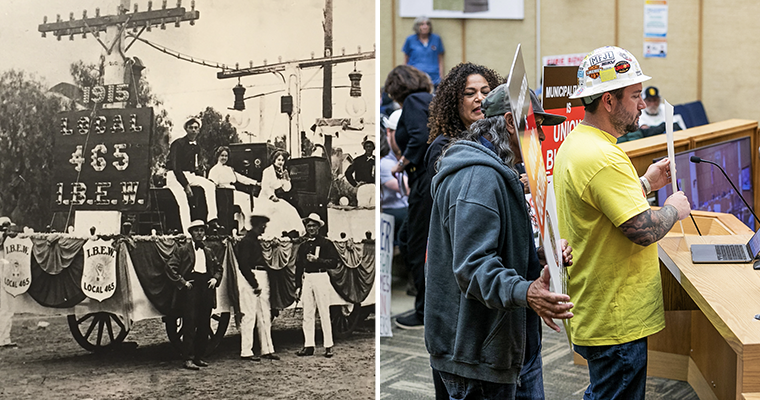
The charter arrived June 4, 1904, and thus was born Local 465. Though it cannot be confirmed, it’s very likely that some of its founding members once belonged to Local 94. And when the inside workers of Local 465 split off to form Local 569 in 1920, they too brought the legacy of Local 94 with them. This month, the IBEW is proud to host its 41st Convention in San Diego, a city where the pioneering spirit of electrical workers has remained for 125 years.
Visit nbew-ibewmuseum.org for more on how to support the IBEW’s preservation of its history. Have a an idea for this feature? Send it to [email protected].