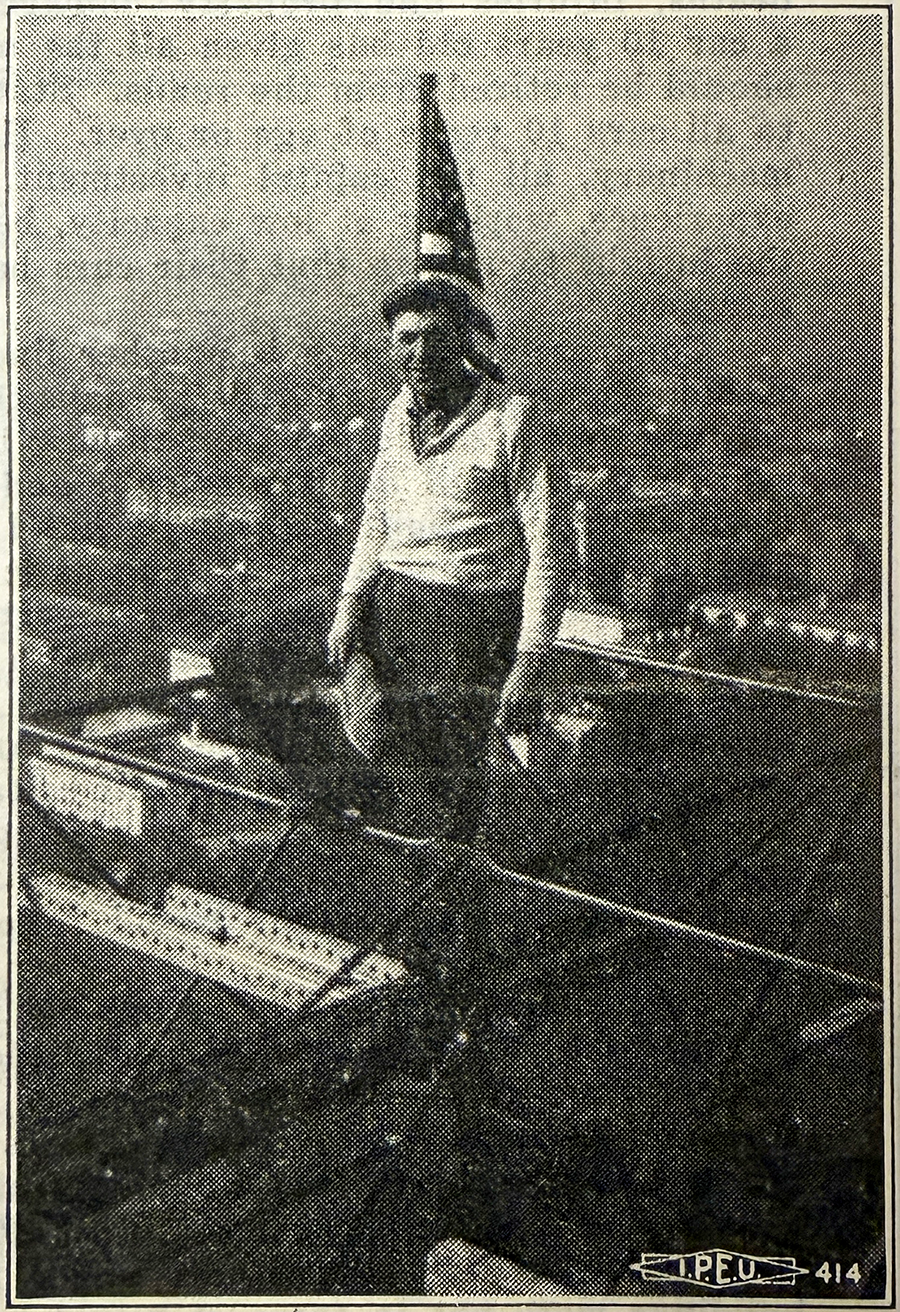
In 1934, during the height of the Great Depression, members of Washington, D.C., Local 26 found themselves atop the Washington Monument. It had been 50 years since the completion of the 555-foot-high obelisk, and the monument was in need of structural and electrical repair. With tools and a camera in hand, Local 26 members documented their work in the November 1934 issue of The Electrical Worker.
In December 1799, 10 days after the death of President George Washington, a congressional committee proposed to build his tomb within the Capitol. Due to a lack of funds and disagreements with his family, the project was sidelined. Progress began anew in 1833, when a group of citizens formed the Washington National Monument Society to raise money for a design competition. After a long wait, the architect Robert Mills of South Carolina was selected in 1845 for his obelisk design.
Construction of the memorial began in 1848 using marble from the Cockeysville Quarry in Maryland. When the structure reached 150 feet, the project was suspended from 1854 to 1877 due to funding challenges. When construction resumed in 1878, this time with funding from Congress, the marble was harvested from a different Maryland quarry, resulting in the monument’s two-tone color. The obelisk was completed in December 1884 and capped with an aluminum apex weighing 100 ounces. An internal elevator carried visitors to an enclosed observation desk at the top.


After 50 years, the first restoration of the monument began as a public works project in 1934. Using funds provided by the federal Public Works Administration — a creation of President Franklin D. Roosevelt’s New Deal — the National Park Service hired several union contractors for the job, including the H.P. Foley Co. for scaffolding and the Alexander Howie Co. for electrical. A tubular steel scaffold was erected, which completely covered the shaft of the monument.
“Well, boys, top o’ the morning to you!” began the 1934 article submitted by Local 26, the author listed only as “The Crew.” The bulk of the maintenance work was in repairing the mortar “courses” between the marble blocks, many of which had begun leaching through the walls. “All the courses both lateral and vertical, up to the line of demarcation (150 feet) were cut out with carborundum wheels to a depth of one and one-third inches deep and one-fourth inch wide,” the author wrote. “Above the line of demarcation, the vertical joints only had to be cut.” This was because the mortar on the lower portion, being much older, had long since disintegrated due to the great weight on it.
The final repair was for the aluminum apex. Surrounding the apex was a wide gold-plated copper band holding eight lightning rods 3 inches in length. After 50 years of lightning strikes, most of the rods were damaged. “The work of Old Thor could be noted quite plainly,” said the author. “The rods were bent and slightly burned, and the aluminum point was five-eighths of an inch shorter.”
The Local 26 crew removed the old rods, replaced them with new 6-inch rods and polished the apex. When lightning did strike, the rods carried the current into the monument itself through four larger copper rods embedded in the stone, which in turn were connected to four iron columns supporting the internal elevator. The current is then discharged through a sand-filled cavern sitting at the bottom of the columns.
Repairs were completed in February 1935, and the monument was reopened to visitors. The author ended the article by acknowledging the Local 26 members who braved the heights: J.F. McDonough, E.R. Leister, E.A. Coppage, James W. Beall, J.I. Creager, A.T. Bartlett and E.A. Fritz. Thanks to these brothers, the world’s largest stone structure continues to stand tall and inspire the millions who visit the capital city every year.
Visit nbew-ibewmuseum.org for more on how to support the IBEW’s preservation of its history. Have a an idea for this feature? Send it to [email protected].