The Super Bowl. The Daytona 500. The Final Four. The Masters. The World Series.
If you’re lucky, maybe once in your life you go there in person and see an event like this for yourself.
But most of us, most of the time, see it through someone else’s eyes and hear it through someone else’s ears.
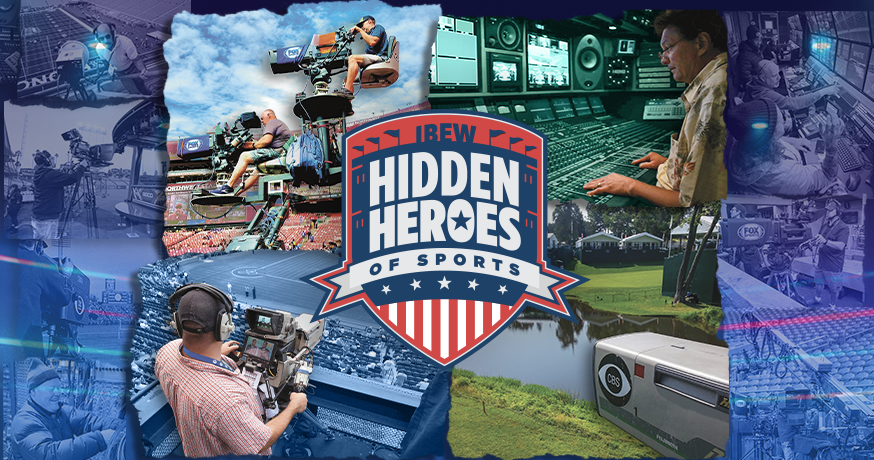
For at least 85 years, at the most important sporting events, those eyes are IBEW cameramen and those ears are IBEW audio techs.
This month, we are highlighting some of the stories of the people who are always there and allow us to be there, too.
“I am extremely grateful for the work every member of the IBEW does. We keep the light and heat on, build hospitals, keep our telecommunication system up and running. What our news and sports broadcast members do is just as critical, and we are without question the coolest branch of the IBEW,” said Broadcast and Telecommunications Director Robert Prunn. “For millions and millions of people, some of their happiest moments and best memories are from games where every sound and image is the product of our hands.”
The Broadcast Department has three national agreements with CBS, Fox Sports and PGA Tour Entertainment and a fourth national unit — organized this winter — that is in negotiations for its first contract.
Washington, D.C., Local 1200; New York Local 1212; Hollywood, Calif., Local 45; and Chicago Local 1220 are signatory to all three national agreements. A fifth broadcast local, St. Louis Local 4, is signatory to Fox Sports and PGA Tour Entertainment.
But there are 59 other locals with the broadcast classification in their charter, and the IBEW has 231 other non-national contracts at local television, radio and streaming services, handling everything from local TV news to “The Late Show.”
The 2025 Super Bowl was the most-watched broadcast in television history. Nearly 130 million people watched in the U.S. alone.
It was Fox Sports’ year to air the game, so it was IBEW members who made it happen.
They join a lineage that stretches back at least to 1932, when St. Louis Local 1 hired Thomas McLean as its radio worker organizer.
Over the last year, we’ve spoken to broadcast members working some of the most-watched sporting events about being there — at the World Series, the Indy 500, the NFC Championship and more.
We spoke to some of the best camera operators in the world, and we spoke to temporary “utilities,” who have a normal job but on the weekend will run behind the cameras, “paging” — or corralling — cables.
Behind the Broadcast
Broadly speaking, sports broadcast crews are a mix of techs and utilities.
Techs are the broadcast specialists. They have years of training and often decades of experience. IBEW brothers and sisters operate the cameras, the microphones and the editing software.
Other techs may have skills more familiar to our construction members. This is the army that swoops in with tons of equipment and wires and cables a temporary broadcast location the size of a stadium.
“Every Super Bowl, every World Series, every Masters — millions of people see the game, but nobody sees the hands that brought it to them. That’s the mark of our members’ skill. When the work is perfect, it’s invisible,” said Broadcast International Representative Neil Ambrosio.
“There is no algorithm that frames a walk-off home run. There is no software that knows when to hold on a quarterback’s face after a fourth-quarter interception, or how far to push the roar of the crowd after a game winning basket before pulling it back so you hear the call,” he added. “That instinct, built over thousands of games and decades of experience, belongs to our members. It’s what makes them elite in their craft.”
Within each category, there are sub-specialties. There are operators for robotic cameras; handheld sideline cameras; and Chapman carts, the motorized elevated camera carts that drive up and down the sidelines.
“The relationship we have with CBS, the PGA and Fox Sports, it rolls right into the contracts we are able to negotiate and the respect the members get on the job. It’s our job to make sure that our members are rewarded at the level their work deserves,” Prunn said. “Everything we have, everything in the contracts, everything in the length and strength of these relationships, is built on their exceptional skill,” he said.
Working beside and supporting the techs are the utilities, a catch-all term for the people who do whatever else needs to be done.
“Utilities do anything from running behind the cameraman paging cables at NFL games to holding monitors for on-track commentators to anything we need,” said Broadcast International Representative Vinny Butler.
When crewing utilities for a game broadcast, the IBEW looks locally. Prunn and Butler are happy to have more locals get involved to assist broadcast locals, particularly in new locations.
To increase the pool of potential utilities, each year Butler runs utility trainings at non-broadcast locals.
“If the local hasn’t done it before, I will come out with a CBS or Fox Sports production representative and an experienced utility and run a training. You will learn how to be a utility,” Butler said.
The training familiarizes people with the tasks they might be asked to do, where to stand, and how to recognize and handle the different kinds of the miles of cables — fiber, audio and coaxial — that make the broadcast possible.
“For our techs — the camera, sound and graphics operators — being at these big events is cool, but they are there because they are the best in the world and this is their job,” Prunn said. “The utility position is the front door into this industry. Your IBEW membership puts you in pit row at Daytona or walking the course with Scottie Scheffler — and if you want to build that into a career behind the camera, the path is right in front of you.” See some of their stories below.
“I love my job. When you take a picture and post it and you’re at the Super Bowl or the World Series, people write, ‘I wish I had your job.’
I’ve worked postseason baseball, the All-Star Game, the Final Four, a lot of golf in the summertime. A little football, too.
This year is my first Indy 500, and I was very excited. Me being into cars, it’s a thrill for me. This is one of the biggest places in the world you can watch a race or any sporting event. The place is huge: 2 ½-mile track and 250,000 people, and we have sets all around the stadium: the Snakepit, Turn 1, the podium and the Pagoda. It’s a challenge, and you adjust and adjust.
But it’s got good days and bad days. It sucks getting up at 4 a.m., hustling all day in the heat. It looks easy when I just post the picture, but man, it took a lot of skill to get here. It’s hard. We lose a lot of people who can’t take life on the road, but I wouldn’t change it. Hopefully I can keep leveling up.”
Chase Norman
Washington, D.C., Local 1200
“I’ve been doing this for 33 years, and I started at the bottom, getting hot dogs and water for the guys.
To be honest with you, for 4 ½ hours on Sundays, this is the best job on the planet. I mean, I can’t imagine doing anything else.
I grew up watching these games every weekend. I would stay in front of the TV from 1 to 7 every Sunday. I watched every football game I could possibly watch, and now I am out here doing it.
They trust me to get shots that … well, I won’t say no one else will get. I am looking for things no one else is looking for. I don’t have an assignment on the show. My assignment is the best picture. I don’t follow every play. If a guy fumbles the ball and … I see that guy on the sideline, between every snap I will get on a shot of that guy on the bench to see his face, to see the emotion of what is going on within him.
That’s my job, to get the emotional shot.”
Mario Zecca
New York Local 1212
“Utilities have always been the backbone and the grease that make these shows work.
Leading up to the Indy 500 and before coming to Indiana, we had many weeks of online meetings with members of the track, the network, coming up with plans and ways to execute the plans.
We are the first on site to unload, prepare gear and run cables throughout the entire venue. My role is to facilitate the needs of the multiple studios, tech-wise, personnel-wise. Anything.”
Lou Dermilio
New York Local 1212
“I’m a utility on a part-time basis. The IBEW brings on local people, and you help Fox Sports however you can. At Indy, I walked with a commentator down by the racetrack holding a ‘jerk’ camera and a monitor for them to watch the race.
I don’t think people realize when they are watching an event on TV, especially an event of the size of the Indy 500, just the kind of coordination and equipment it takes. You can only imagine how many hours of manpower it will take to unplug this! You have cameras at every corner. Wires, cables. It’s something to behold watching it all come down. I’ve broken down NFL games. But this? You have a 2 ½-mile oval. It’s mind-boggling how many people it will take.”but I wouldn’t change it. Hopefully I can keep leveling up.”
Eldon Wheeler
Indianapolis Local 481
“This is my fourth or fifth World Series, and when you first do it, you do get that butterfly feeling before you go out. We have thousands of people that are actually here, millions more watching on TV. So, it’s kind of exciting to be right out there with the top athletes, the top cameramen, producers and directors. And I feel really happy and excited to be part of it.
A lot of times when you are not above the line, it’s easy to say ‘I’m just a utility’ or ‘I’m just a runner,’ but I believe that every job is equally important. There is an art and a science to everything that happens. A lot of people don’t realize how much happens, from pulling a cable to directing. So for me, where I come in, I do whatever it takes. It could be running thousands and thousands of feet of cable or hauling equipment around, holding lights or just … waiting.
It’s cool to be so close to the action. I feel blessed to be part of that.”
Jen Frye, New
York Local 1212