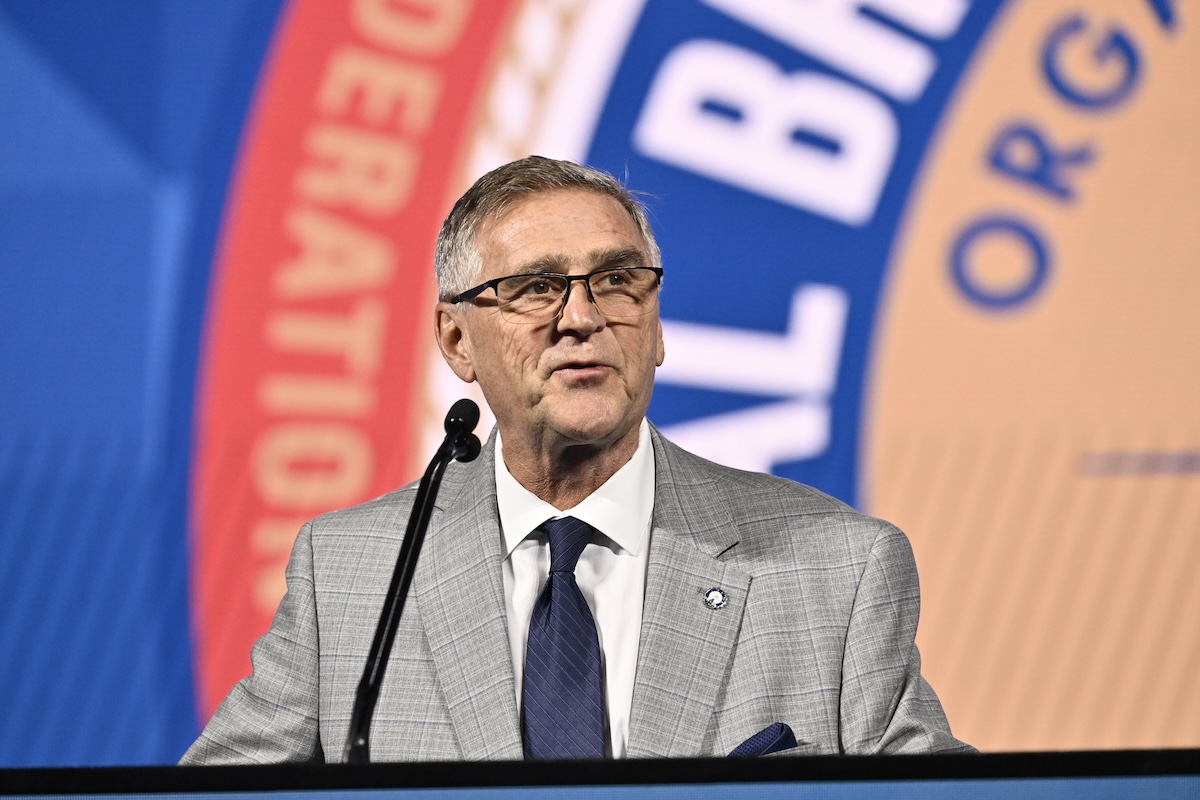

AFL-CIO President and IBEW Sister Liz Shuler brought delegates to their feet Sept. 22 as she hailed the union as a trailblazer, celebrated the movement’s growth and emphasized the work ahead, from electing pro-worker lawmakers in November to protecting jobs in the new AI universe.

“Wherever this economy is moving, the IBEW is moving with it — thinking about where the work will be five, 10 years from now, and making sure those jobs become good union careers,” Shuler said in a speech filled with IBEW pride. “That’s the mentality our entire labor movement needs.”
A member of Portland, Ore., Local 125 and former assistant to the late International President Edwin D. Hill, Shuler was reelected in June as the first woman to lead the AFL-CIO.
While calling her job an “incredible honor,” Shuler also told delegates: “I’m most proud of being your IBEW sister. To be here is like coming home.”
Since she was first elected in 2022, the federation has skyrocketed past its organizing goal — a million new union members in 10 years — and now is determined to organize 2 million more inside five years.
The IBEW’s own record-breaking growth spurs Shuler’s optimism.
“Sisters and brothers, this union is on a tear right now — 24,000 new members last year, the most in a single year in half a century, and 37,000 more this year,” she said to cheers.
Praising the IBEW’s leadership team, she cited International President Kenneth W. Cooper’s pivotal role on the AFL-CIO Executive Council.
“I am so damn proud of the vision he’s brought in this moment and his relentless focus on organizing and growth,” Shuler said. “Thank you for taking risks and challenging us all to be bold, and that’s what we need in this moment.”
She stressed that the movement’s continued growth and power to fight for workers’ rights is directly tied to the choices voters make at the polls between now and Nov. 3.
“I know some people get uncomfortable when we start talking politics. But here’s the thing: Politics is already making decisions about us every single day — whether we can organize freely, whether our collective bargaining rights exist. Whether we’re safe on the job and our retirements are going to be there for us,” she said.
The AFL-CIO has committed to train 50,000 election-protection volunteers this fall and turn out 16 million union voters and their families — 2 million more than in the 2022 midterms.
“That means helping people register to vote,” Shuler said. “Making sure they understand when and where they can vote, staffing voter-protection hotlines, as this administration keeps trying to intimidate people and discourage them from voting.”
She said a new and critical question for candidates is where they stand on workers and artificial intelligence.
“We need to make sure the future of work is defined on our terms,” she said. “If I’m out there on a power line, is AI going to be making decisions about our crew size, dispatch, workload, safety — without listening to the people who actually work around thousands of volts of electricity every day?”
Likewise, she said wiremen building giant data centers need to know if AI’s opportunities also mean invasive monitoring and pressure to work faster or cut corners.
She pointed delegates toward the Workers First AI Initiative, launched by the AFL-CIO last October.
“We put our stake in the ground. We said: ‘Here are our demands: We want humans in control. We want our seat at the table. We want training and upskilling for our workers. We want our civil rights protected. And we want our basic right to organize.’”
No matter how much technology has evolved, she said, “one thing that’s never changed is the power of this union.”
She’s understood that power since childhood, when her father became a Local 125 lineman apprentice. “It changed everything for our family. That’s what the IBEW does. It changes generations.”
In a world where tech billionaires and anti-worker politicians have far too much control, she said the IBEW has a major role to play in building an economy that works for working people.
“One where innovation doesn’t mean leaving workers behind,” Shuler said. “Where jobs can sustain a family, where young people look at an apprenticeship the same way my dad did and say, ‘That’s my ticket to a better life.’”