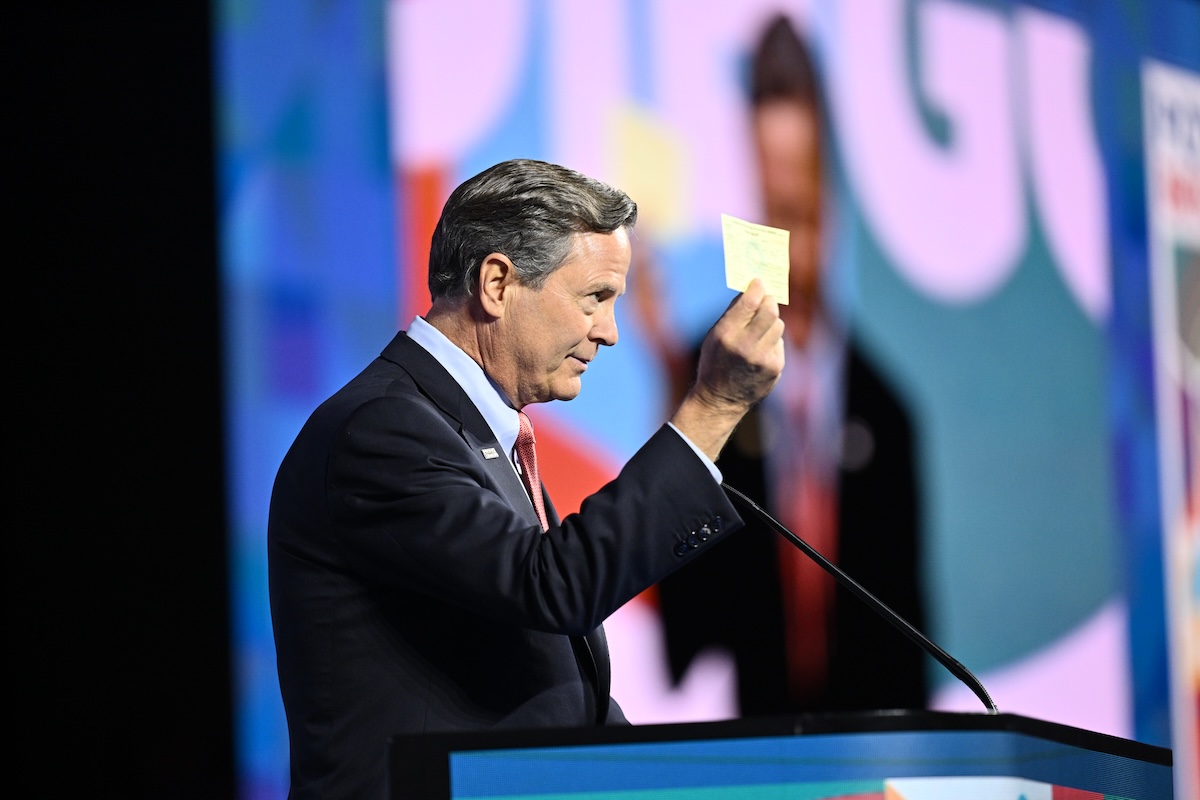

International President Kenneth W. Cooper won election to a five-year term Sept. 22 at the 41st IBEW International Convention, setting the stage to keep the union on the path of unprecedented growth forged in the first three years of his presidency.
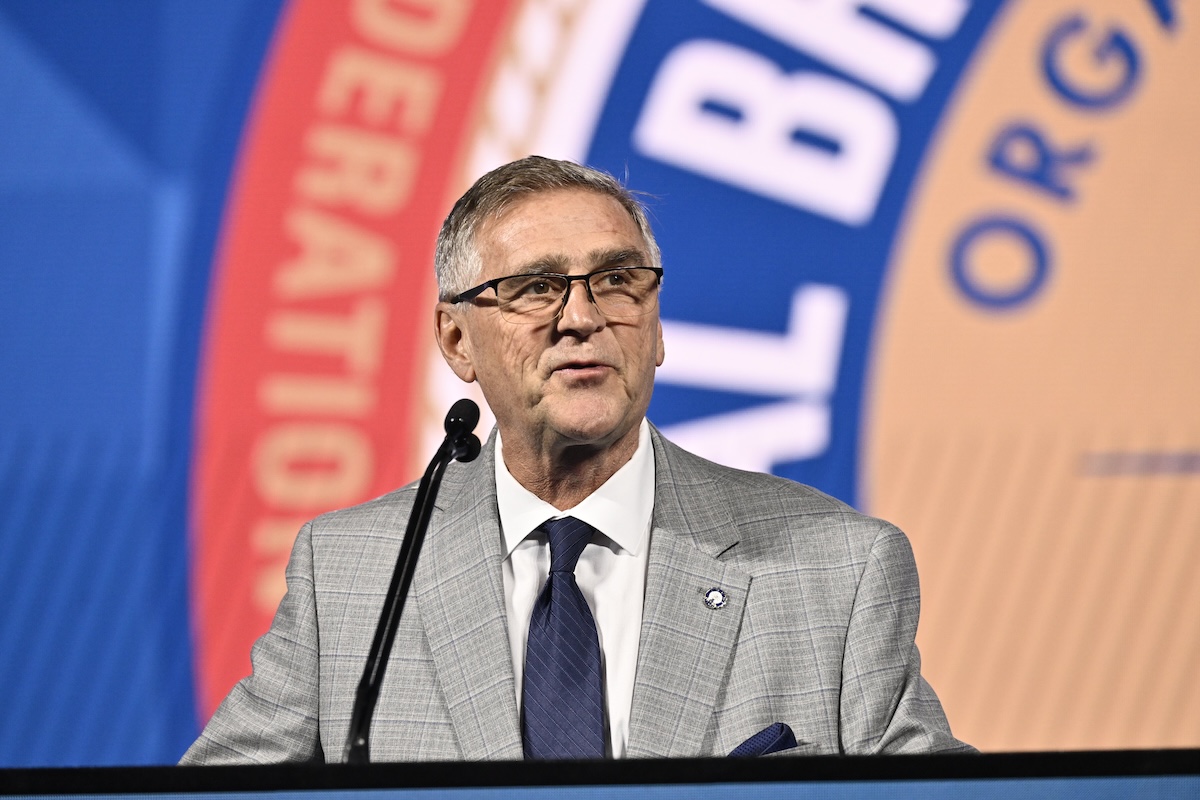
“What an incredible four years it has been since we last gathered in Chicago,” he said in his address to the assembled delegates. “Just look at what we set out to do four years ago at our last convention, and look at what we’ve accomplished since.”
Cooper was nominated by New York City Local 3 Business Manager Christopher Erikson Jr. on Sept. 21.
“Because of the leadership of President Cooper, who so boldly and publicly claimed to this membership since day one of his tenure that the IBEW will reach 1 million members again, we are closer than we’ve been in over 40 years,” Erikson said.
After the election results were announced, Cooper began by thanking the convention delegates for electing him to his first full five-year term. Cooper was appointed international president by the International Executive Council in January 2023 after the retirement of Lonnie R. Stephenson.
“Thank you so much for placing your trust in me to serve this great Brotherhood of ours for another term. I say it everywhere I go: Serving as your international president has been the honor of my life,” he said. “I’m humbled by your faith in my leadership, and I vow always to give my all.”
Cooper also thanked International Secretary-Treasurer Paul Noble, International Executive Council Chair Joe Calabro, the other elected leaders of the IBEW, and his senior staff.
“I’m so lucky to serve with the best leadership team in all of labor,” he said.

Cooper then told his own story and how the IBEW changed the trajectory of his life.
“Every person in this hall has a story of their own,” he said. “We are here in San Diego to chart the course for a bigger, stronger, more united IBEW.”
The most consequential commitment of the IBEW since its last convention, and the most ambitious, he said, was the rededication to organizing.
“We haven’t just been organizing. We’ve been breaking records. We have more journeyman wiremen than at any point in our history. More journeyman linemen than at any point in our history. More apprentices than at any point in our history. Recorded more hours worked than at any point in our history,” he said.
In 2022, the IBEW had 775,000 members. As the convention began, the membership had grown to more than 920,000.
Cooper credited policies enacted since the last convention — the 12,000-hour rule, four-year apprenticeships, district organizing plans and Strategic Winning Action Teams — for driving that growth.
He also lauded recent critical agreements that safeguard and grow the union’s work: the Tri-Trade Agreement and the consolidation of the National Maintenance Agreement, the General President’s Project Maintenance Agreement and the National Construction Agreement into one national agreement.
“The Tri-Trade Agreement with the Laborers and Operating Engineers ensures that solar work is IBEW work, protecting our transmission and underground work and finally cutting the Carpenters out altogether,” he said. “The consolidated agreement means better wages and benefits, including stronger overtime provisions and shift differential pay. Critically, all IBEW outside work is excluded from the agreement, ensuring that outside work remains IBEW work. It also protects all our solar work.”
With so many new members working so many hours, and with skilled electrical workers in such short supply and high demand, Cooper said the IBEW was able to win benefits that had been priorities for IBEW for the decades.
“We set up the first new IBEW pension plan since 1949, the NEIB, and we got the first NEBF increase in two decades, from $32 to $33 for every year of service, all the way back,” he said.
Cooper then turned to where he sees the IBEW going in the years ahead.
“Economists predict that the United States and Canada will need nearly 100,000 new electrical workers every year for decades to come,” he said. “The real question facing us isn’t whether we’re growing. We know we are. It’s whether we’re growing fast enough. Because this work is going to happen, whether we’re ready for it or not.”
Once again, Cooper exhorted business managers to finally end policies that keep people working under IBEW contracts out of membership.
“The days of telling potential recruits to get to the back of the line are over. If you work in our industry and you pay your dues, then, from Day One, you are a full-fledged member of the IBEW,” he said. “In the 1890s, turning people away was a luxury our founders didn’t have. And in 2026, it’s a luxury we don’t have, either.”
Neither is excluding communities that traditionally haven’t found a warm welcome in the trades.
“We need to recommit our support for our affinity groups like the EWMC, RENEW/NextGen, and our Women’s and Veterans’ committees,” he said. “Besides helping us organize in different communities, they are mentoring the next generation of the IBEW leadership and ensuring that new members become lifelong members and leaders.”
Finally, he turned to the poisonous politics driven by President Donald Trump.
Trump has sabotaged the National Labor Relations Board, he said, making it harder for unions to organize and win, and stripped collective bargaining rights from more than a million federal workers — including IBEW members. Cooper noted that this administration has killed tens of thousands of energy jobs that were going to put IBEW members to work and rolled back health and safety protections.
“[They] are turning Americans against one another. Dividing us by race. By gender. By sexual orientation. By immigration status. By religion. It’s the oldest anti-union trick in the book: get working people fighting among themselves so they forget what they have in common. We cannot fall for it,” he said.
The antidote, he said, isn’t in attachment to either party. Its building our own power.
“We’ve come from different backgrounds. Different regions. Different industries. Even different nations. But we are united by one mission: power. The power to improve lives. The power to give working people a voice — on the job, in our communities, and in the halls of power,” he said.