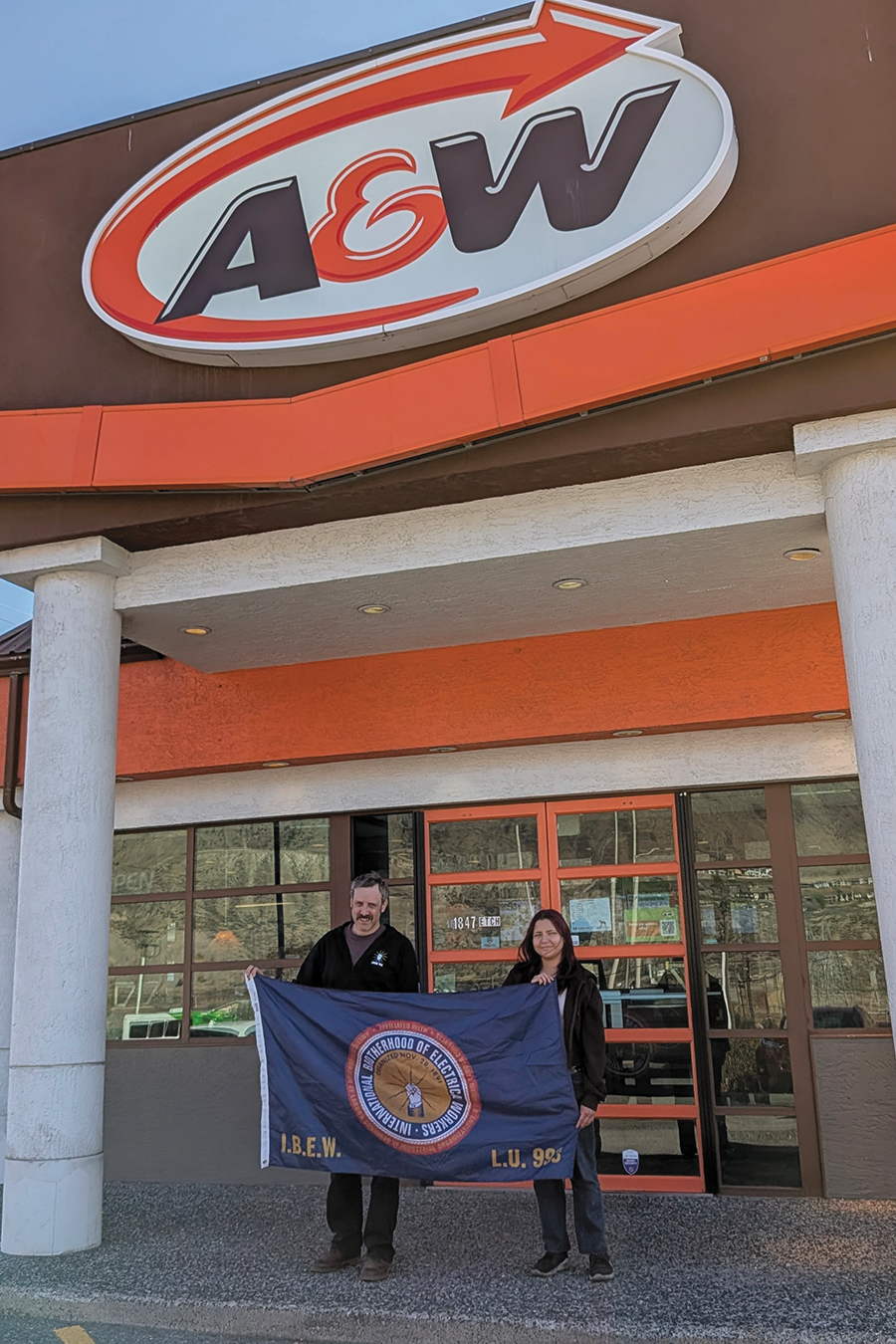
After making history as the first A&W workers to unionize in Canada, 20 new members of Kamloops, British Columbia, Local 993 are celebrating another victory: a first-ever contract after 18 months of bargaining.
“We’re really happy about it,” said steward Keira Sampson. “I think people are being treated way better. I would say that good rules are in place and workers are standing up for themselves more.”
The two-year contract includes just-cause protections and progressive discipline that Sampson said has led to fewer firings. It also creates a new A&W-supported fund that workers can tap for college or other post-secondary education.
Despite the prolonged contract talks, Local 993 organizer Brian Andrews said there’s mutual respect between the union and management.
“We built a good relationship,” he said. “They were a little standoffish at the start, but once they realized we weren’t going anywhere, they were more agreeable. It’s gone well overall.”
Andrews said the contract didn’t increase wages because A&W pays at or above British Columbia’s minimum of $17.85 an hour — the equivalent of almost $13, well above the federal minimum wage in the United States.
Beyond being unique to Canada, the Kamloops location appears to be the only unionized A&W in North America. The century-old chain — America’s first fast-food franchise — became famous for its root beer floats in frosty mugs and car-hop service that eventually gave way to drive-thru windows.
With 42 A&Ws throughout British Columbia, Andrews said, future organizing is possible. But he cautioned that the timing has to be right.
Successful union drives in the fast-food industry are rare in Canada and the United States, between employer opposition and a revolving door of potential members as restaurant workers come and go.
Notably, several IBEW locals in the Midwest and California have beat the odds with hard-won organizing and contract victories over the past three years at regional coffee chains.
For the A&W unit, a revived card-check law in British Columbia removed the biggest hurdle to organizing: elections and the period of time they give employers to wage anti-union campaigns.
Passed by the New Democratic Party in 2022, the law allows bargaining units to be certified without a vote once 55% of workers sign membership cards.
Unionization in the province immediately shot up. After the law’s first full year in 2023, the BC Labour Relations Board reported that 92% of nearly 200 certifications had been achieved through card check.
The A&W drive “would have been a lot harder” without the new law, Andrews said. “Given how long it takes for a vote to happen, everyone who signed a card could be gone by the time there’s an election.”
Even the process of collecting cards was tricky, as would-be members left for new jobs, college or other opportunities.
“The high turnover was one of our biggest challenges,” Andrews said. “People quit, they graduate from high school, they move to management. We’re constantly trying to stay up to date with members to let them know they’ve got a union and that they can talk to their shop steward about any issues.”
The churn in recent months has included two stewards. Now 19-year-old Sampson is shepherding the unit on her own with Andrews’ help.
“Keira might be the youngest steward we’ve ever had in Local 993,” he said. “She’s doing a good job.”
Sampson said it’s stressful at times, but she’s learning a lot and enjoying her role.
“I felt like it was a really good cause,” she said about being recruited by one of the previous stewards. “I believe in equality, and I like helping people out. And I really like helping my co-workers.”