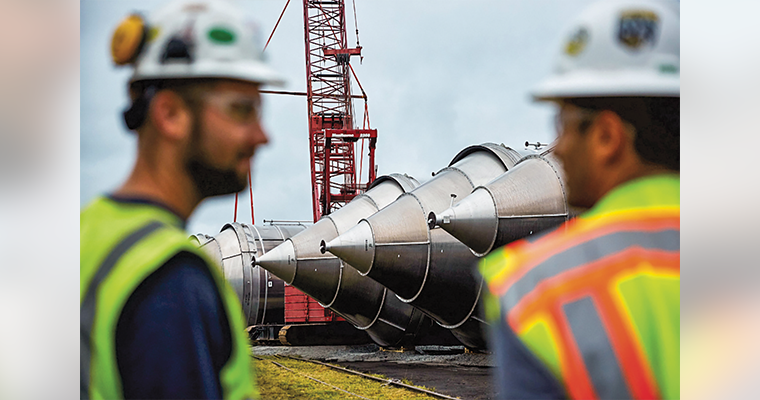
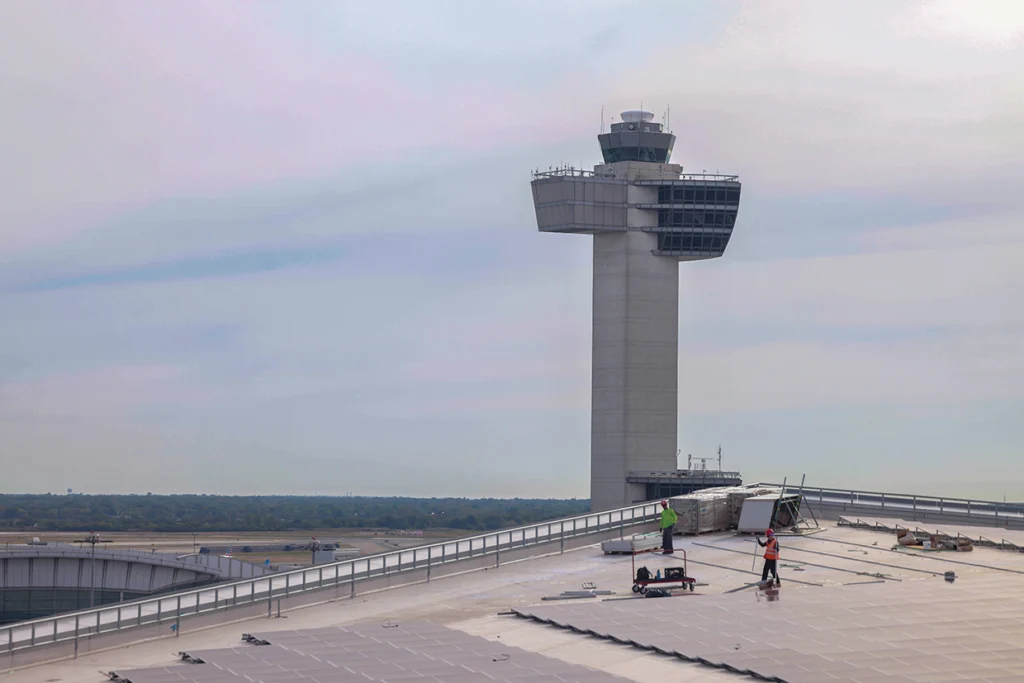
Nearly 1,500 New York City Local 3 members are working on upgrades at John F. Kennedy International Airport, including the dozens of electricians installing on a new Terminal 1 building what will soon be the city’s largest rooftop solar panel array.
Soon, the members of New York City Local 3 will no longer be able to boast that the rooftop solar installation they just installed on the Jacob K. Javits Convention Center in Manhattan is the city’s largest.
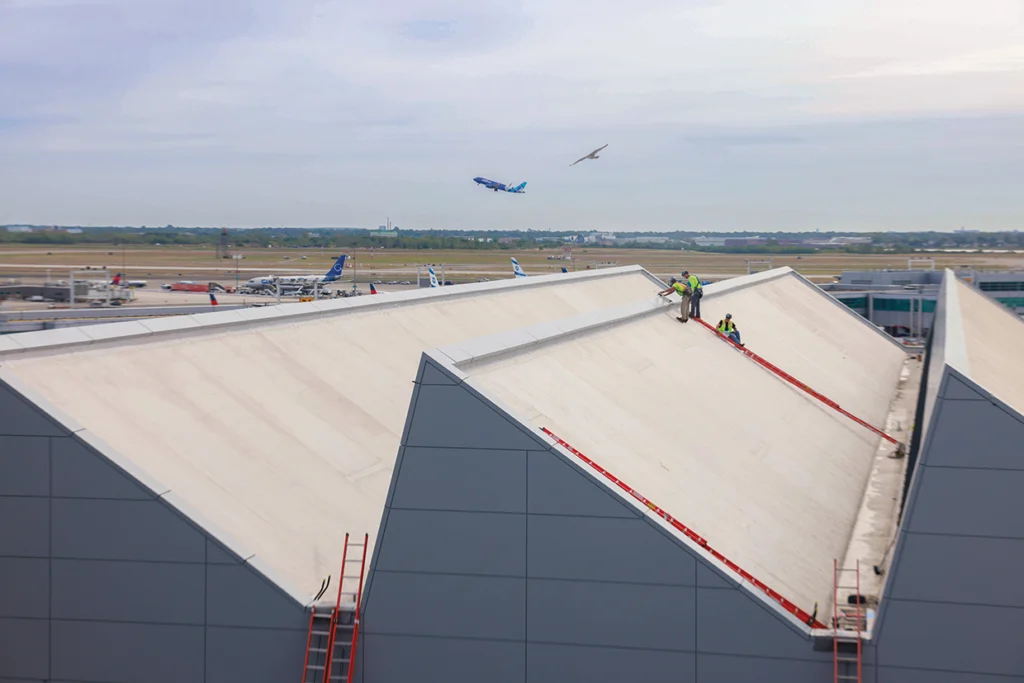
That’s because several dozen of the local’s electricians are working to hand that distinction to an even bigger site in the city — the 13,000-panel array they’re placing atop a new international terminal at John F. Kennedy International Airport.
Those Local 3 solar installers have been working with nearly 1,500 of their brothers and sisters on the electrical upgrades that are part of the entire airport’s $19 billion transformation project. It’s not just the largest ongoing infrastructure development in the local’s jurisdiction — it’s one of the biggest in the U.S.
“The amount of work that this whole project has generated for my local and my members has been very welcome,” said Local 3 Business Manager Christopher Erikson. “It’s solar, it’s power generation — it’s the IBEW’s work, and we do it best. It’s how we keep the union strong at Local 3.”
Planning and development for rooftop solar at JFK’s Terminal 1 has been going on at least since 2021, said Anthony Badalamenti, vice president of power and renewables at Local 3 signatory E-J Electrical Installation Co.
“We bought all the solar panels, the racking and the equipment early to keep the project on time,” said Badalamenti, a former Local 3 member. “We had everything staged, and we had the equipment ready for installation and rigging” in coordination with the local authorities and the Federal Aviation Administration.
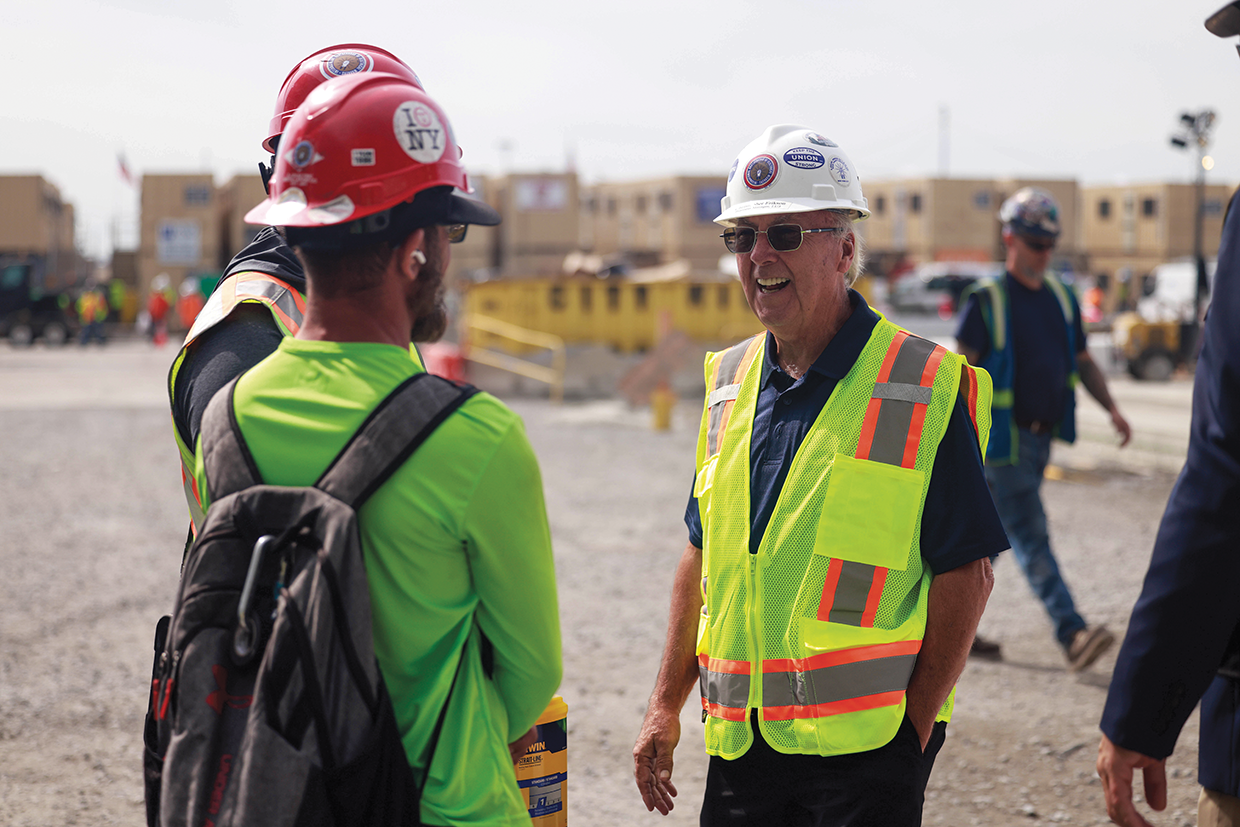
As many as 50 Local 3 electricians — with at least a 15% apprentice-to-journeyman ratio — have since enjoyed steady prevailing-wage work on the project, including on some Saturdays when the weather cooperated.
“We got lucky this year. We didn’t have a really rainy season that held us up,” Badalamenti said. “When you’ve got good weather, you’ve got to keep everybody moving.”
Working on Jamaica Bay in Queens — at an active international airport that handles more than 1,200 arrivals and departures every day — has added a measure of difficulty to the project, said Badalamenti, whose company also handled the solar installation at Javits.
“I don’t think it’s so much the noise,” he said. “You’re right on the water there, and you’re on a roof all day. There’s no wind stoppage, and the temperature feels 10 degrees colder most of the time.”
And with solar panels measuring as much as 4 feet by 7 feet, “we’re always cognizant of high-wind days,” he said. “They’re like sheets of plywood. You’ve got to have two journey persons handling [panels] all the time, because they could take off on you and you don’t want a panel on the runway.”
To protect workers from the elements, E-J provided high-visibility long-sleeve shirts and extended brims for their hardhats. “We also brought some tents up there to bring some shade for breaks,” Badalamenti said.
Local 3’s installers also have had to account for Terminal 1’s variety of rooftop angles.
“I’ve been to the project a number of times,” said Erikson, who also chairs the IBEW’s International Executive Council. “The design of the roof, the patience of putting the panels in, how beautiful it looks — it’s really amazing.”
Jobsite inspectors also have been making sure that any reflection glare from the panels won’t blind air traffic workers in JFK’s nearby control tower.
“The roof is pitched at nearly every angle, like flower petals,” Badalamenti said. “With a lot of solar jobs, no one gets to see the work. Here, you’re going to be able to fly in and see it.”
The whole airport upgrade is covered by a project labor agreement with the Port Authority of New York and New Jersey. “We have great relationships with the Port Authority, the major carriers — the whole site,” Erikson said.
Terminal 1, which is taking over the former sites of Terminals 2 and 3 to become JFK’s largest, is scheduled to open the first of its 23 gates this summer and then continue to phase in to full operation over the next four years.
“We’ve got to be online in March,” Badalamenti said. “We’re getting close to mechanical completion. We’re in really good shape with where we are.”
Local 3 electricians also have installed six hydrogen fuel cells to deliver supplemental electricity to the building. Together, the cells and Terminal 1’s 6.63-megawatt solar array are expected to generate enough renewable energy to meet the needs of the 2.4 million-square-foot facility on what’s slated to become the biggest self-contained airport microgrid in the U.S.
Badalamenti said that future Local 3 solar work at JFK will include installation of a rooftop panel array on a new 1.2 million-square-foot Terminal 6, along with a parking lot solar canopy, battery storage and ongoing maintenance for all of it.
Local 3 electricians will also upgrade wiring at the other terminals, and they’ll be fully involved in the airport’s construction of a new ground transportation center and a revamped road system.
All these upgrades at JFK were “long overdue,” said Erikson, who noted that members of his local recently completed electrical upgrades as part of the $8 billion renovation of nearby LaGuardia Airport.
“LaGuardia looks great, and JFK is going to equal it if not exceed it,” Erikson said. “We’re building a world-class gateway to the United States here in New York City.”
The business manager credited the hundreds of Local 3 members working all over the airport site.
“Our men and women bring to the table skills, productivity and safety,” he said. “We’re proud to be doing it, and I’m proud of our members, who perform at 100% every day on every job.”