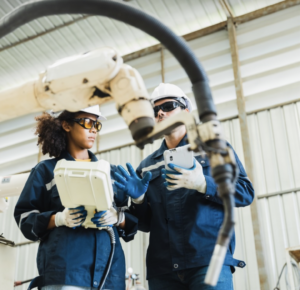
Mary Honzik couldn’t have imagined her present-day IBEW sisters, women who string high-voltage power lines, wire complex construction projects, even serve as foremen supervising their union brothers on work sites.
But it’s easy to imagine the pride she’d feel, realizing what generations of barrier-breaking women had accomplished in the 130 years since she broke one herself.
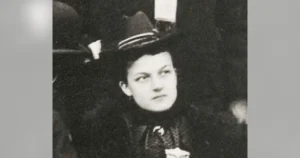
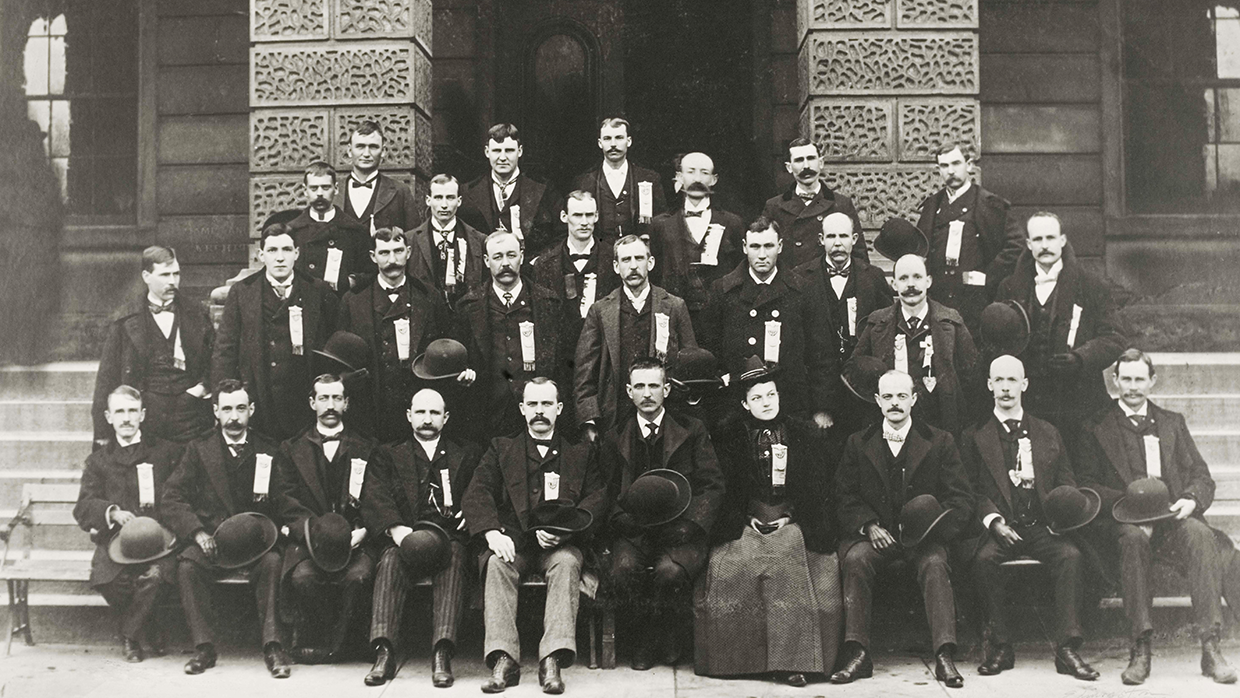
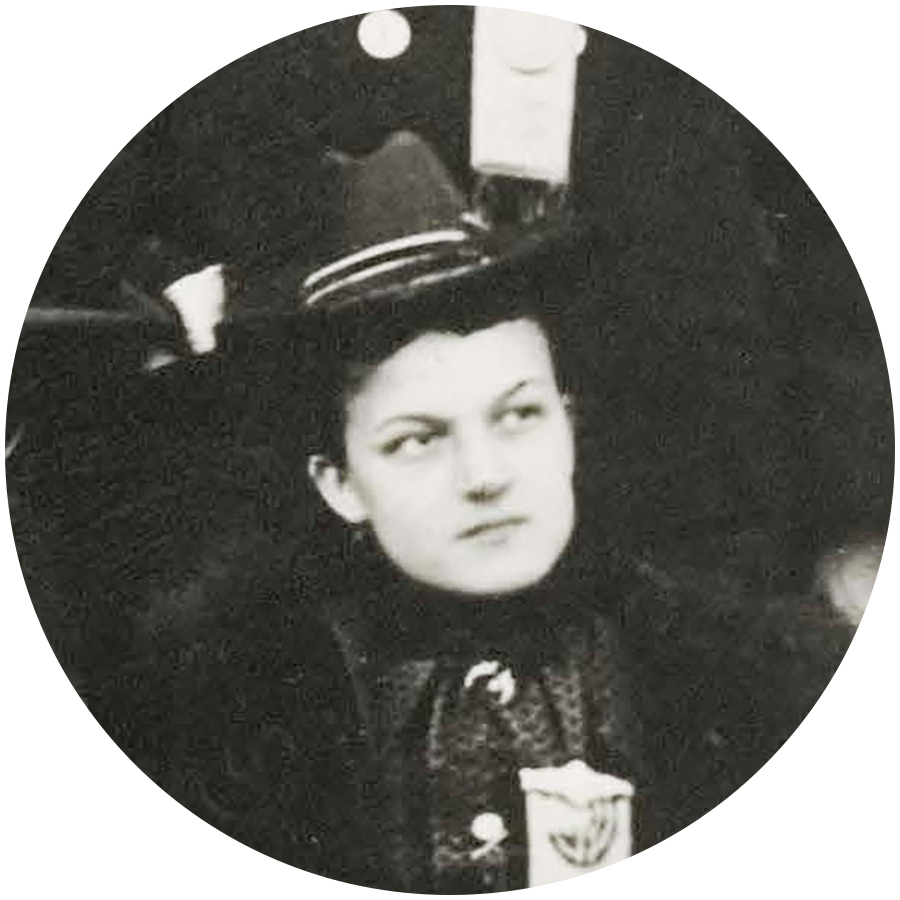
“Mrs. Mary Honzik of St. Louis,” per The Electrical Worker’s report, was hired in 1896 as the IBEW’s first woman organizer, doubling what had been a one-man shop. It was a historic first among all unions that still exist today, few of which, if any, had paid organizers at all in the 1890s.
Determined to seize on opportunities in the rapidly expanding electrical industry, IBEW officers understood that volunteer organizers were no longer enough. Electrical manufacturing plants were growing in number and size, creating thousands of new jobs producing switches, meters, transformers, insulated copper wires, light bulbs and every other kind of component.
As demand soared, so did the number of women on the factory floor. For manufacturers, it was a win-win: They valued women for their dexterity on assembly lines and didn’t have to pay them as much as men.
A Milestone in Cleveland
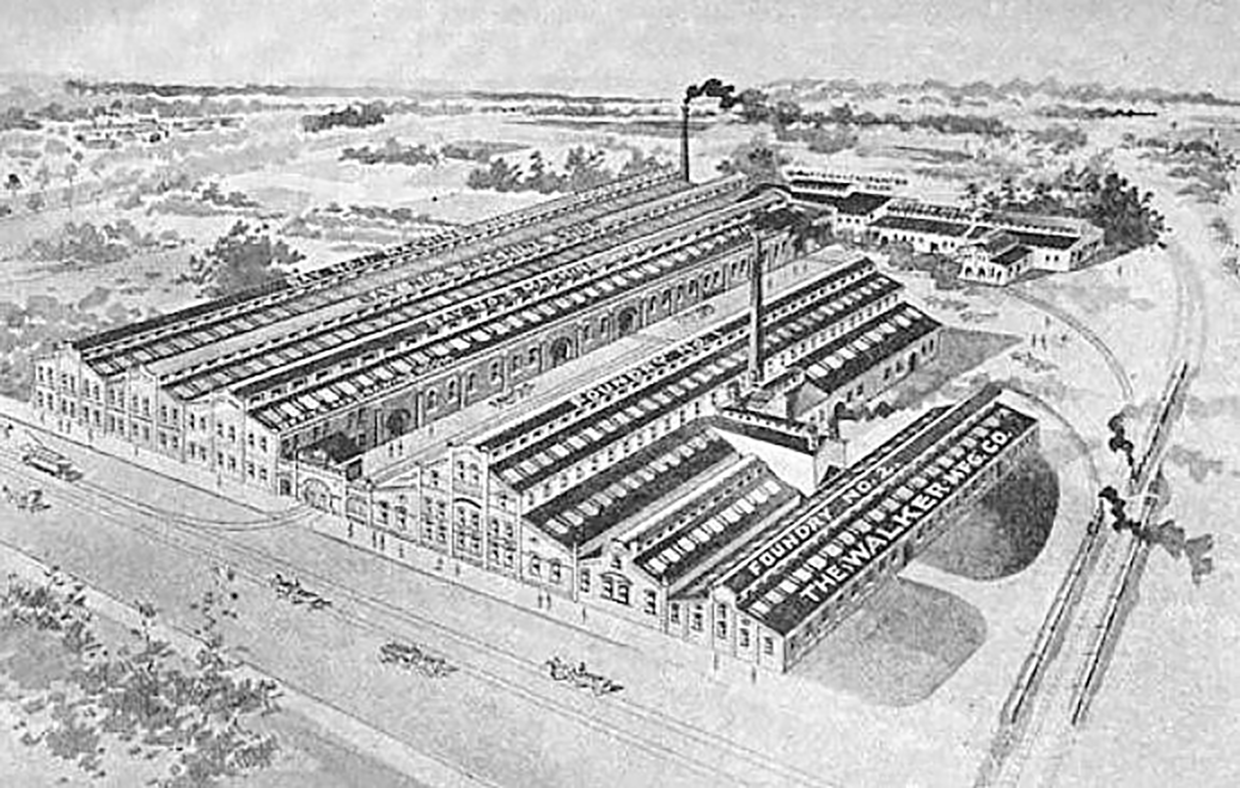
Within a year of hiring Honzik, the IBEW had another first to celebrate — an all-woman local, led by the first women to serve as officers. Organized by Local 38 in Cleveland, Local 80 represented 21 women at Walker Manufacturing Co., which produced streetcar and electrical equipment.
The Electrical Worker hailed it as the only independent company of its kind at a time when large manufacturers were racing to swallow up smaller ones. Walker, the paper stated, “is bearing the brunt of the battle against this powerful combination of electrical interests — this attempted monopoly of a great hold of industrial effort.”
But it couldn’t fend off the giants for long. As the paper’s October 1898 edition reported:
“The Walker Manufacturing Co. (has) been absorbed by the Westinghouse Co. of Pittsburgh. Well, the Walker Co. was a straight union shop from start to finish, all branches of work being thoroughly organized. It was one of the most strict union shops in Cleveland.”
While it spelled the end of Local 80, the mettle of the IBEW’s earliest women proved that they belonged. They’d found champions among their brothers, men who knew that sisters would make the Brotherhood stronger.
Thomas Wheeler, press secretary and later grand president of Local 38, advocated as much in a May 1897 submission to The Electrical Worker:
“There is another subject I would like to see discussed in the ‘Worker,’ and a very important one it is, especially to those employed in the manufacturing business, and that is the organizing of the girls who work at the electrical business. It is a well-known fact that a large part of the work done in the electric manufacturing establishments is done by girls. They take the place of men, do the work of men, and for less pay. Now, what are you going to do about it? That they should be organized there is no doubt, but how and in what form is it to be? … I would like to hear from some locals upon this point. Chicago, Detroit and Buffalo, what do you think about it? Wake up and let us know.”
Wheeler didn’t reveal how close his local was to the history-making win at Walker, which came within weeks of his published plea. An editorial in The Electrical Worker made the announcement:
“Only one new Union to report for the month of May, which appears in our directory as No. 80, but if our readers stop to closely read what follows they will notice quite a difference in the names of the officers from those in any of the 79 preceding unions. No. 80 marks an epoch in the history of the electrical workers, as this is the first union of female electrical workers ever organized. The union started with 21 charter members, and fifteen at the next meeting, and is good for several hundred members.”
It had been five years since delegates to the union’s Second Convention in 1892 passed a resolution stating that “any electrical worker” may be eligible for membership. Without specifying “women” in the text, it was a somewhat begrudged welcome. But it was enough. That year, six telephone operators, including Honzik, became the first woman members.
Known as “Hello Girls,” telephone operators made up the vast majority of IBEW women for decades, originally organized into existing telecom locals across the country. But in 1912, the union chartered its second all-woman local, or sub-local as it was categorized, an arm of Boston Local 103 representing operators at New England Telegraph & Telephone.
Famously, 8,000 of them walked off the job in April 1919 demanding better wages and working conditions. Their five-day strike ended with a $4-a-week raise and collective bargaining rights.
Victory was harder to come by in the early electrical industry, where Westinghouse and a handful of other union-busting manufacturers dominated the market. Even so, other locals were inspired by the win at Walker.
‘They Would Make a Fine Union’
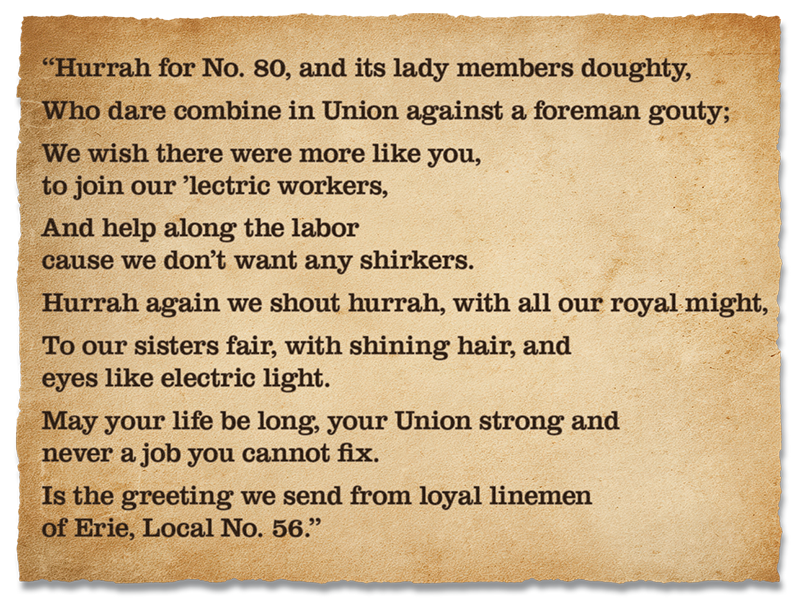
William Birch, press secretary of Schenectady, N.Y., Local 70, had an enthusiastic — if chauvinistic — reply to his counterpart at the Cleveland local:
“Our brother from No. 38 desires to know why the girls in the electrical factories are not more thoroughly organized. I think the real cause in our city is that they are expecting to get married every day, and do not think it worth their while to become members of an organization. … We have in Schenectady, NY about 500 girls who work at the electrical business. They would make a fine Union of electrical workers. Don’t you think so, Bro. Press Secretary of No. 38?”
Local 80 hung on until Westinghouse declared the plant an open shop in March 1899. Though its life was short, the local had thrived, doubling to 43 members and embracing the spirit of sisterhood.
In his back-and-forth with Birch, Wheeler described it joyfully:
My heart aches for Bro. Birch of No. 70. Just think of 500 girls and not an organization of female electrical workers in Schenectady! But just say to those 500 girls that in Cleveland the electric girls have an organization with a membership of about forty. They have one of the best halls in the city, have a piano, and after they are through with the business of the evening, they roll back the carpet and have a waltz or two. The brothers from No. 38 expect to visit them, and so, combining pleasure with business, they are sure to make success of their union. Now, you go tell those 500 girls to form a Local, brace up and be independent, and they will never regret It.”
Visit nbew-ibewmuseum.org for more on how to support the IBEW’s preservation of its history. Have a an idea for this feature? Send it to [email protected].