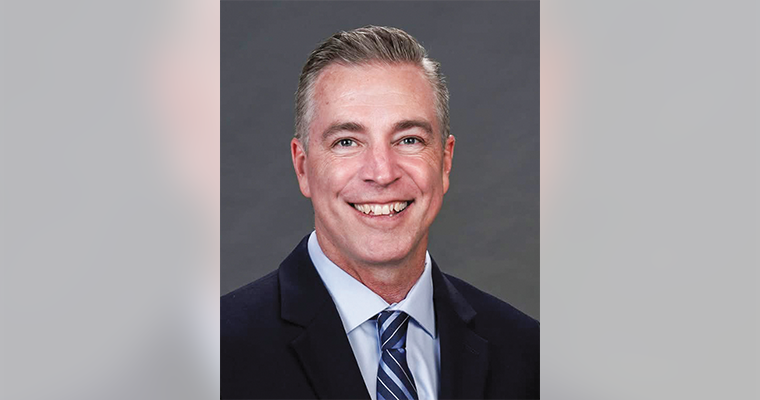
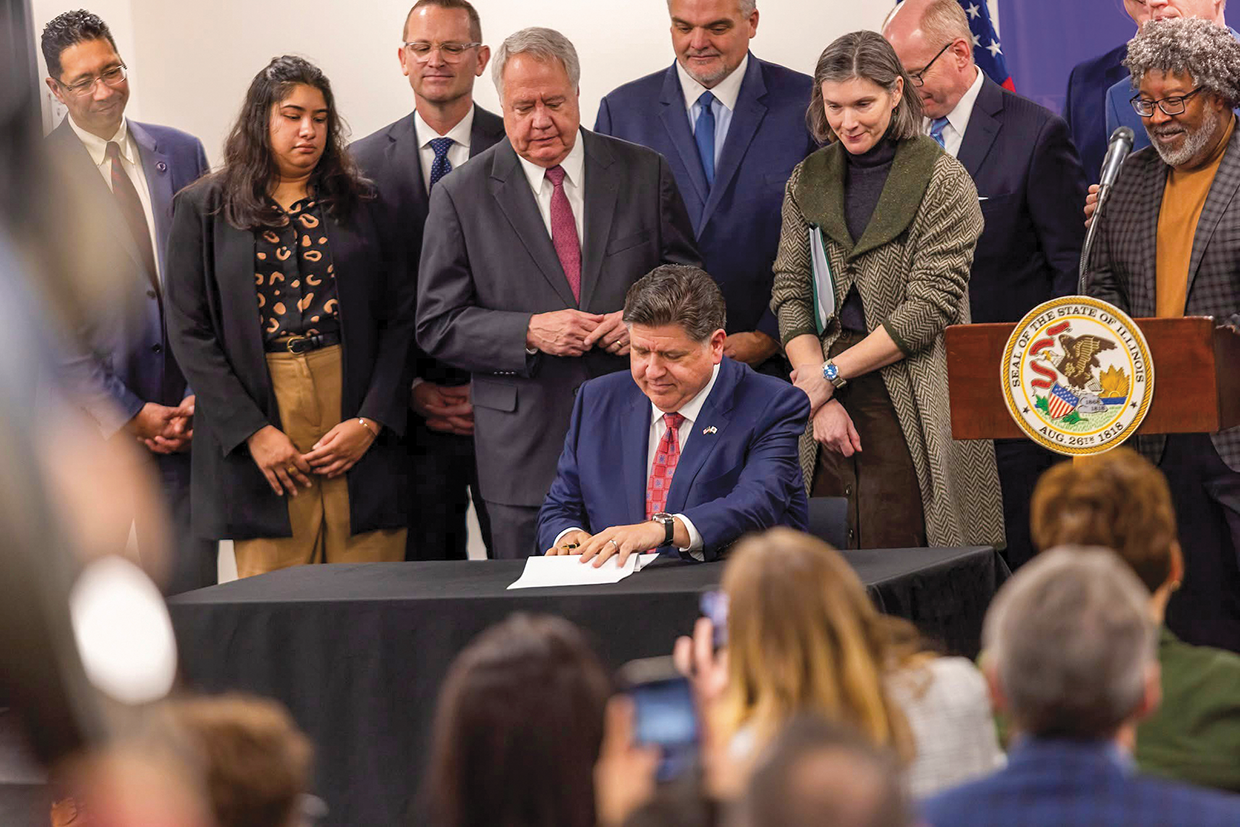
With Sixth District International Vice President Michael Clemmons at his side, Illinois Gov. JB Pritzker signed a landmark energy bill revoking the state’s nuclear moratorium and expanding project labor agreements at the heart of renewable generation and storage.
The Clean and Reliable Grid Affordability Act increases state support for renewables, storage and advanced grid technologies while increasing the number of projects that require project labor agreements.
“If the Inflation Reduction Act was still in place, we wouldn’t have to be doing this. If there was an all-in approach and a labor-friendly government in D.C., we wouldn’t have to do this. Not having any policy at the federal level makes it very difficult, but our job is to look out for our members and keep them working,” Clemmons said. “It’s crazy that we don’t have policy continuity between states anymore, but this is a pretty good model for how states can find a deal that works for labor, consumers, utilities and clean energy types.”
The CRGA is largely an update of the 2021 Climate and Equitable Jobs Act, which has added 6.5 GW of renewable energy to the Illinois grid.
“We wanted to fix the problems in the original bill, but we also need to respond to a world with hyperscale data centers driving exponential load growth,” Clemmons said.
Even though data centers are so far a small part of the state’s load, consumer rates already went up 20% to 25% in 2025, and the power futures auction price in the PJM regional transmission organization for 2026 rose 73%.
Clemmons said the IBEW’s highest priorities were strengthening labor protections and freeing the state to add to its largest-in-the-nation nuclear fleet.
“We lifted a moratorium on small modular reactors less than 300 megawatts last year, but now we can build the full-size 1,000-megawatt reactors as well,” Clemmons said. “We have the largest nuclear construction, maintenance and operations workforce in the country in Illinois. We can do big things.”
One of the “problems” fixed in the CRGA was the 5-MW lower limit on solar projects requiring a PLA. Developers were building projects on a contiguous lot using the same substation, but they were calling them “co-located” 4-MW projects.
“We eliminated that,” Clemmons said.
“[The Clean and Reliable Grid Affordability Act] is a pretty good model for how states can find a deal that works for labor, consumers, utilities and clean energy types.”
– Sixth District International Vice President Michael Clemmons
While they were at it, they also reduced that 5-MW lower limit to 3 MW.
One of the challenges of increasing renewable generation is the intermittency. The CRGA addresses that with 3 GW of four-hour battery storage added to the grid by 2030, all built under project labor agreements.
The IBEW won a significant victory in transmission reform, as well, moving future decisions about siting out of the state Legislature and into the less partisan Illinois Commerce Commission.
The law also pushes forward with grid modernization programs that will create significant work for IBEW utility members. The CRGA mandates the creation of “virtual power plants” that will harness the flexibility of smart thermostats, solar panels, small batteries and electric vehicles to shed load during peak demand, along with time-of-use pricing that will reward consumers who shift their power use to low-demand times with lower prices.
All of that flexibility requires a grid covered in sensors and “grid-enhancing technologies,” or GETs, that will be installed and maintained by IBEW utility members.
“We pushed for the GETs because most of all new generation is renewable and distributed, scattered and intermittent. Yes, the grid upgrades are work for us, but it will also improve reliability and reduce rates,” Clemmons said.
An Illinois Power Agency study found that the CRGA will save Illinois energy customers $13.4 billion over the next two decades.
Clemmons said the Trump administration’s revocation of the IRA is a disaster for IBEW members nationwide, even if they may not be feeling it yet. Production tax credits for new construction end this summer.
“Most of the pain from canceled projects will be postponed until after the midterm elections this year, but long-term planning meetings with developers have completely dried up. Everyone wants to get a shovel in the ground now before the federal tax credits end, but then what? A state-by-state plan is how we have to do it,” he said.