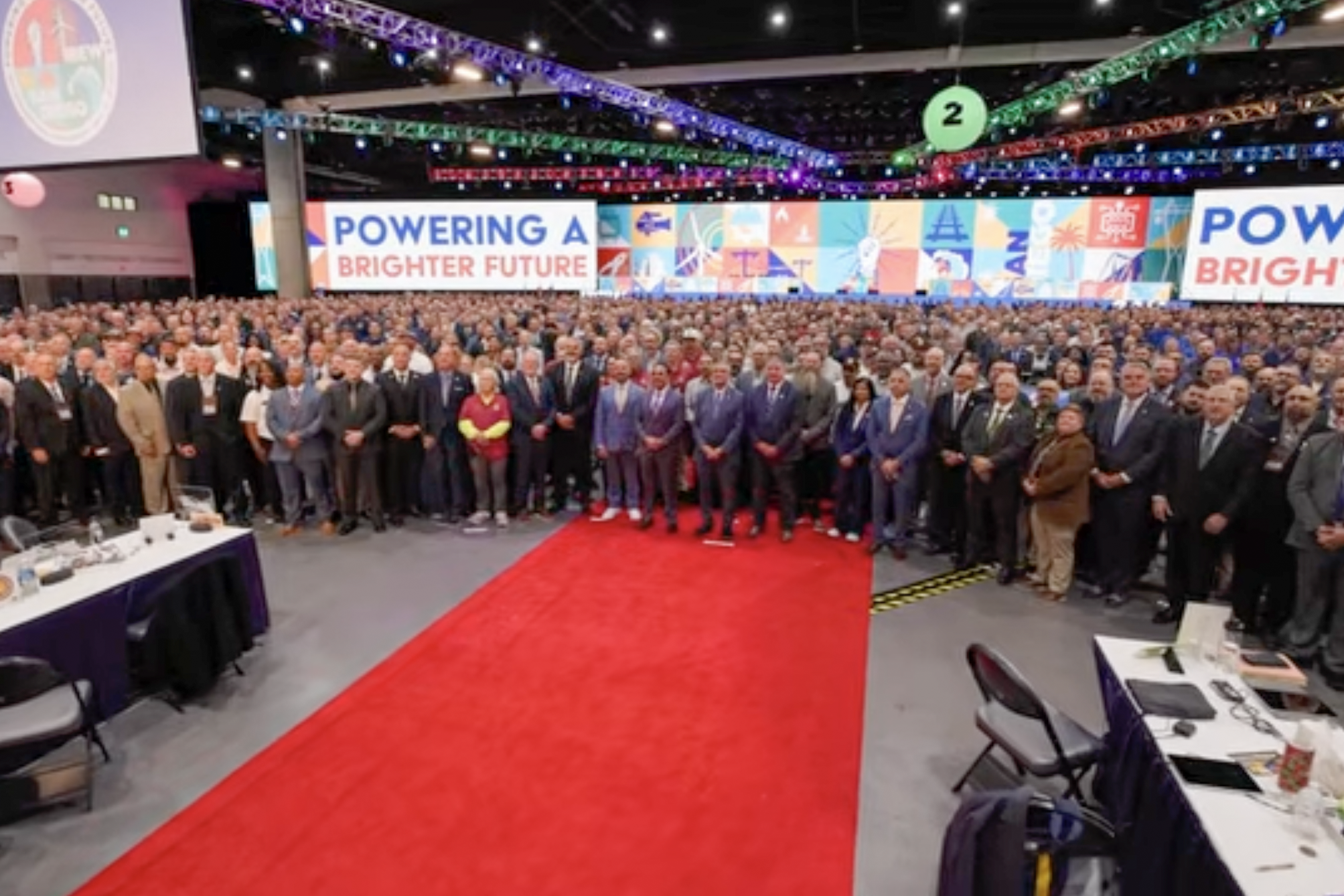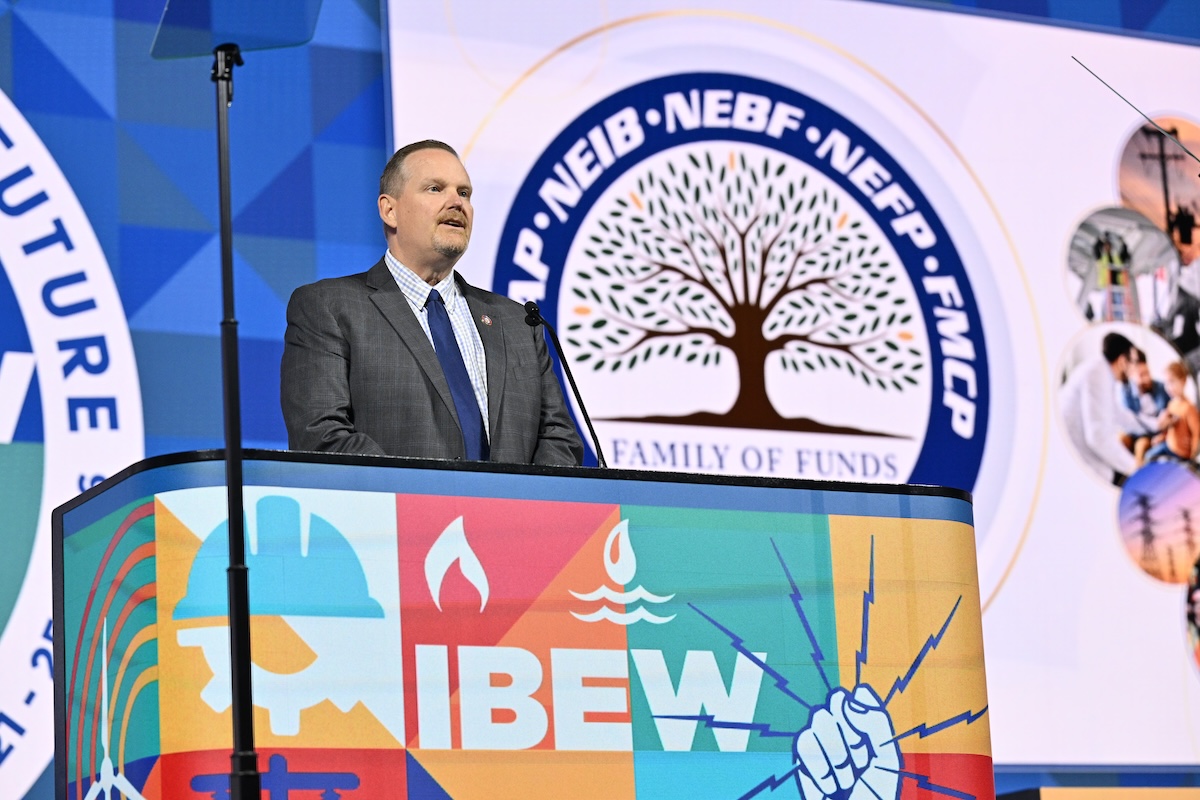

Helmets to Hardhats Executive Director Martin Helms spoke to delegates of the 41st International Convention on Sept. 23 about how his organization has helped thousands of military veterans find union building trades careers — himself included.
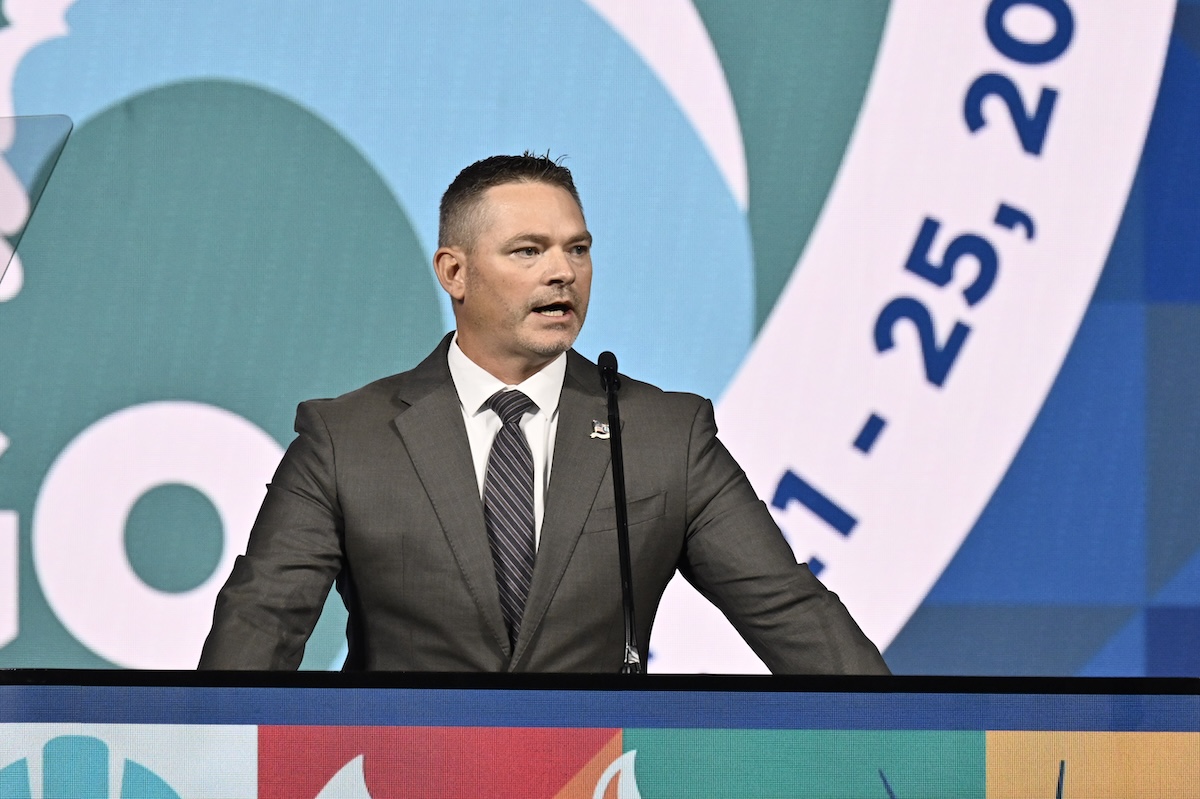
“I came into this Brotherhood as a young man, freshly off a deployment, seeking an opportunity that was real: a pathway to the middle class and a chance to build something solid,” he said.
Founded in 2002, Helmets to Hardhats is a partnership among 15 NABTU affiliates, including the IBEW, to help veterans transition into to careers in the trades.
A member of Akron, Ohio, Local 306 who’s served in the National Guard since 1999, Helms became the first IBEW member to lead H2H as executive director in 2021.
He praised the IBEW for being among the strongest unions when it comes to veterans integration.
“You guys are Number 1 out of all our affiliates,” he said. “With a continued, focused coordination and commitment, this Brotherhood has the potential to be an absolute dominant recruitment resource for our veterans into the trades.”

H2H works hand-in-hand with the IBEW’s Veterans Electrical Entry Program, or VEEP, to support a pipeline of veterans into the electrical trades.
“Together, we expand opportunities available to veterans who want a career in this field,” Helms said. He added that his own electrical career began “with tools in my hands, sweat on my brow and a union that gave me a chance when I needed it the most.”
Across North America, H2H continues to grow, he said.
“Every year, more servicemembers, reservists and National Guard soldiers are looking toward the skilled trades as their next chapter,” Helms said. “The number of career seekers through our program has climbed year after year, and many of them are choosing the electrical industry.”
He said that this year’s H2H recruitment figures are already comparable with the U.S. Army’s 101st Airborne Division at full strength.
“This is the scale of opportunity that’s in front of us,” he said, although there is still a notable gap between interest and intake.
“It’s not a failure, it’s a signal: that with clear communication, stronger coordination and a more consistent use of this program, we can capture more of the talent that is already knocking,” Helms said.
Strengthening partnerships between the electrical industry and veterans requires both parties to work together with clarity, purpose and solidarity, he added.
“Make sure every local understands how Helmets to Hardhats works,” he said. “Make sure every veteran who applies gets a fair and consistent shot, and make sure the pathway is visible, accessible and clearly defined.”
Across the military, service members gain a variety of transferable electrical skills that align directly with the IBEW, Helms said.
“We shouldn’t let that talent sit unused.”
One strategy that would help is tightening coordination between locals and H2H, he said.
“When communication is strong, the veteran succeeds,” Helms said. “When the process is streamlined, veterans get placed faster. And when we operate as partners, the entire electrical industry benefits.”
The IBEW can help veterans build a future with a chance to belong to something bigger than themselves, Helms said, “a place where they can continue serving, this time by building North America.
“Together, we can build the next generation of linemen, inside wiremen, teledata technicians, utility workers, tree trimmers — and, most importantly, leaders.”
The same day as Helms’ address, the convention approved a resolution urging locals to appoint veterans advocates and form Veterans Committees.