
In the final moments before the convention exhibit hall opened to the public the week before the 41st IBEW International Convention, Charlie Tuck was the calm center in a mass of increasingly frenetic last-minute preparations.
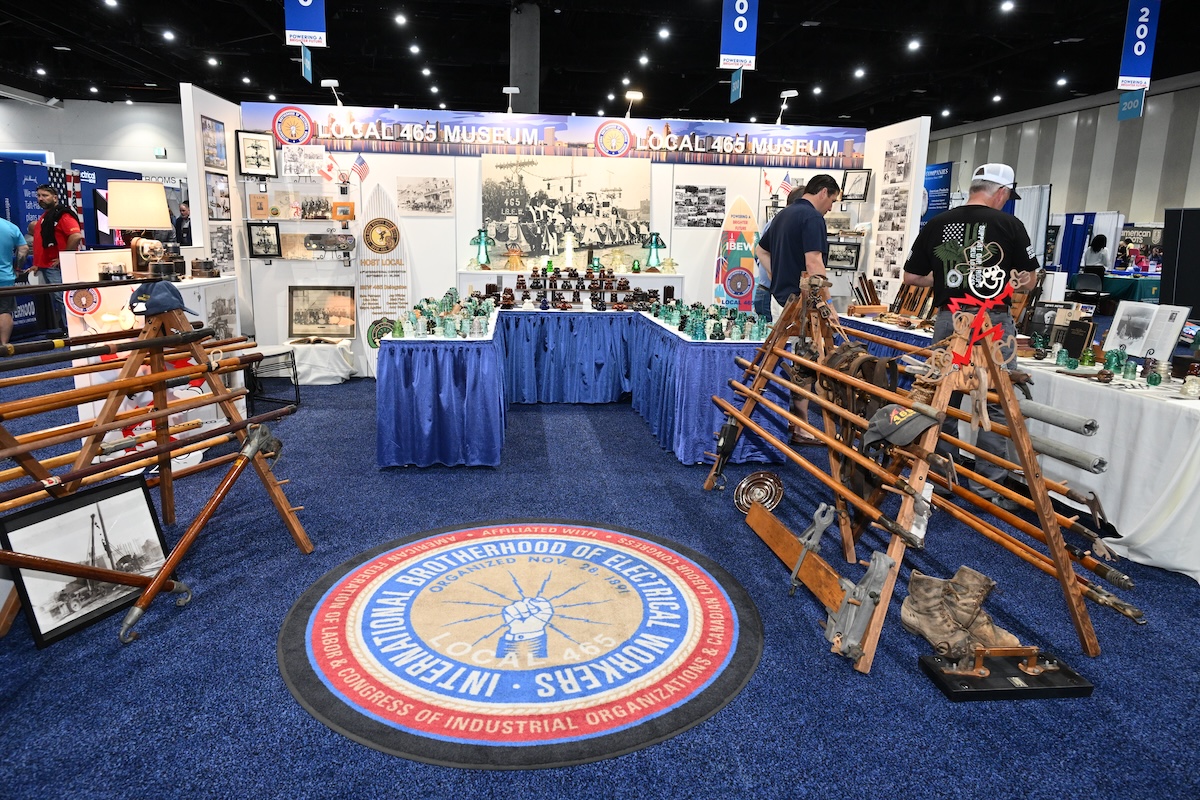
Tuck’s booth was done. He was home. Tuck was the host and curator of the San Diego Local 465 museum, and everywhere he looked were images and artifacts that tell the Tuck family story as much as they trace the evolution of linemen’s tools in far Southern California.
On one side were hand tools and photos that belonged to his father Charlie E. Tuck, and hanging between antique wood-handled hot sticks hung the tool belt of his grandfather William “Whispering” Tuck.
“He was a boomer,” Tuck said, using the term for a construction lineman. “And I don’t think I could fit my leg through that belt.”
Tuck is a third-generation lineman from San Diego Local 465. He worked as a lineman for San Diego Gas and Electric for more than 40 years and retired in May 2025.
The family collection of antique glass and porcelain high-voltage line resistors and vintage tools draws linemen like a porch light draws moths. Especially the 30 oak-handled hot sticks that his father and grandfather used. Using rubber gloves to handle live wires wasn’t allowed in California until the late ’90s, Tuck said.
“These make old linemen smile when they see them. There was something about the finesse you needed to do everything with the sticks that we all miss,” he said.
This is Tuck’s first convention, and the exhibition hall is a much grander venue for his collection than he is used to.

“Normally, I am putting it all out on card tables in the dirt at a rodeo or an SDG&E safety meeting,” he said.
The exhibit includes pictures from the ’40s through the ’80s, including a picture of his father topping out of his apprenticeship in 1964. He has dozens of insulators that he collected, inherited or bought, including glass ones in all colors, Pyrex, rubber, Bakelite and porcelain.
“We all look for the unique ones. The ones that have slumped in the heat or have faded into new colors from the sun. Some have what look like little snowflakes in the glass, and some you keep because they have a unique design,” he said.
His oldest is an iron ram’s-horn insulator, with a chunk of pole wood still attached, that held up telegraph wire along the transcontinental railway in the late 1800s. The rarest, and most valuable, are two pale green high voltage insulators about 10 inches tall that he converted into lamps.
Tuck has a few pieces that show the evolution of conductors, including about 12 inches of a hollow high-voltage copper conductor about an inch and a half in diameter. The sleeve of the conductor is made up of flat copper panels about a half-inch wide with that slowly rotate around the open core. They are held together by tongue-and-groove joints. He also has another piece that has solid copper wire sheathing and a twisting copper I-beam running through the center.
“I have no idea how you splice that,” he said, staring at the chunk of it in his hand.
What he likes about the old tools is the way they show tradesman adapting and learning as the trade changed voltages increased.
“I’m really into the history of line work, and I want the younger guys to know where we came from,” he said.