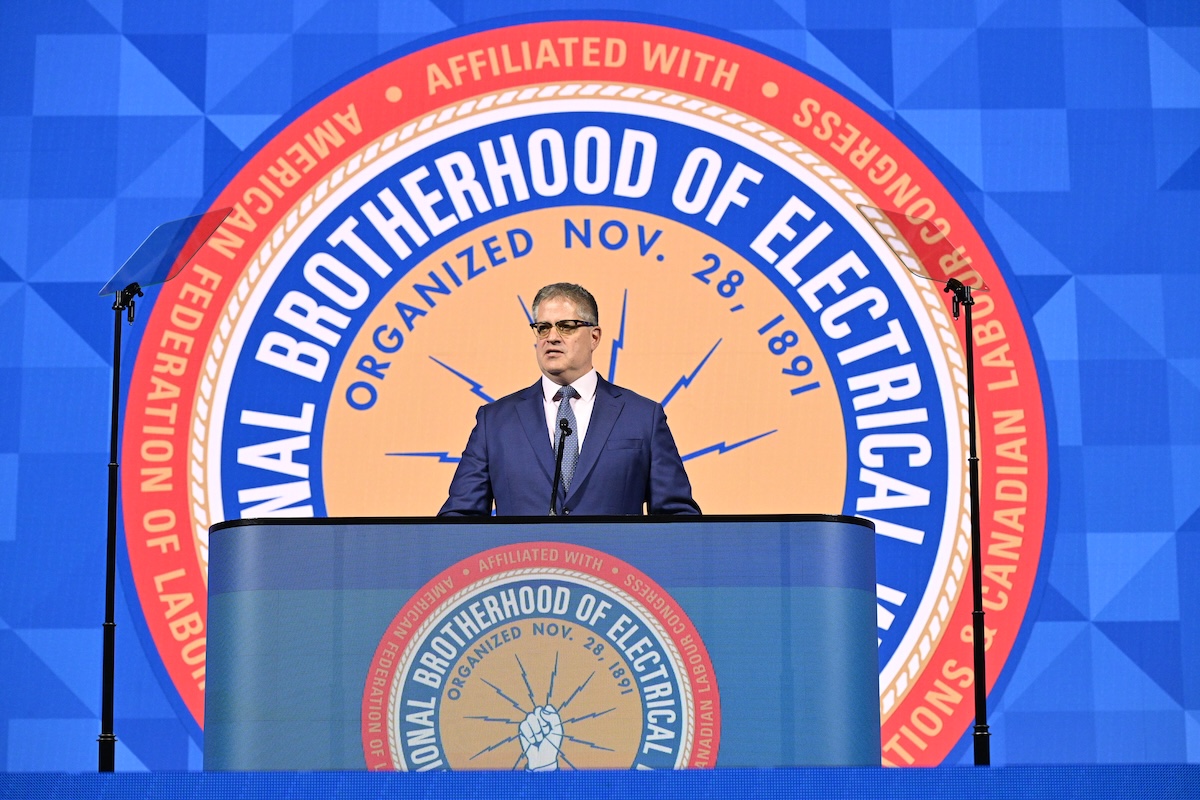
IBEW General Counsel Jon Newman addressed the delegates to the 41st IBEW International Convention on Sept. 25 with a clear-eyed message about the political and legal realities facing the IBEW in the middle of the second Trump administration.
“Law school teaches you that nothing – and I mean nothing – is random. Nothing is the result of the ‘natural order of things.’ Nothing is just the result of free market forces. Instead, everything is the result of law and policy choices that elected leaders make,” said Newman, who has represented the labor movement before many courts and agencies, including Congress, the National Labor Relations Board and the Supreme Court.
And the reality, he said, is that even though times are good for many IBEW members, there is an assault on organized labor and working people in the U.S.
“There is nothing magical about being an electrician that says you will have a solid middle-class job. The reason IBEW members are solidly in the middle class is not because they are electricians. … It is because they are IBEW electricians,” he said.
Since the last convention, Newman said, multiple decisions by the Supreme Court have attacked the foundations of American organized labor.
In 2024, the Supreme Court ruled 6-3 in Loper Bright that administrative agencies like the NLRB and the Department of Energy are not entitled to any deference from the court for their decision-making. Instead, unelected judges and justices can now more easily overrule those agencies’ decisions.
Then earlier this year, in Trump v. Slaughter, by an identical 6-3 decision, the court ruled that the president has the power to fire members of “independent” federal agencies such as the NLRB for any reason.
“Take those two cases together, and our model of federal labor law in the United States, which has been in place since 1935, is less stable and less predictable than it has ever been,” Newman said. “It makes it harder for you to do your jobs and organize because, even if you succeed at the NLRB, courts now have more room to overturn that victory and hand management and the nonunion sector a win.”
The good news, he said, is that it doesn’t have to be this way. There is an election just weeks after the close of the convention, and every leader in the IBEW has an opportunity to get out to the membership and talk about taking power back.
“You must be the ones to deliver that message because no one else will. And you need to, even if it is personally easier as matter of union politics not to,” he said. “I don’t care if it is a town council race or a U.S. Senate race, we must … get out of the local union office, go to jobsites and have those conversations.”
As leaders in their locals, delegates at the convention are in the best position to educate members, Newman said.
“IBEW members are fed a constant stream of political messaging about who they should elect. But none of it concerns who is best for the IBEW. None of it concerns who will help us negotiate the strongest contracts possible. None of it concerns who will help us secure work for years to come. And none of it concerns who will ensure that we can organize the unorganized. You must be the ones,” he said.
Newman urged the delegates to listen to members and answer their concerns, Newman said, but tell them the truth about which candidates will not just talk about jobs but will fight for unions.
“Leave this convention hall fired up, go home, get out the vote, and continue to fight the good fight,” he said.